


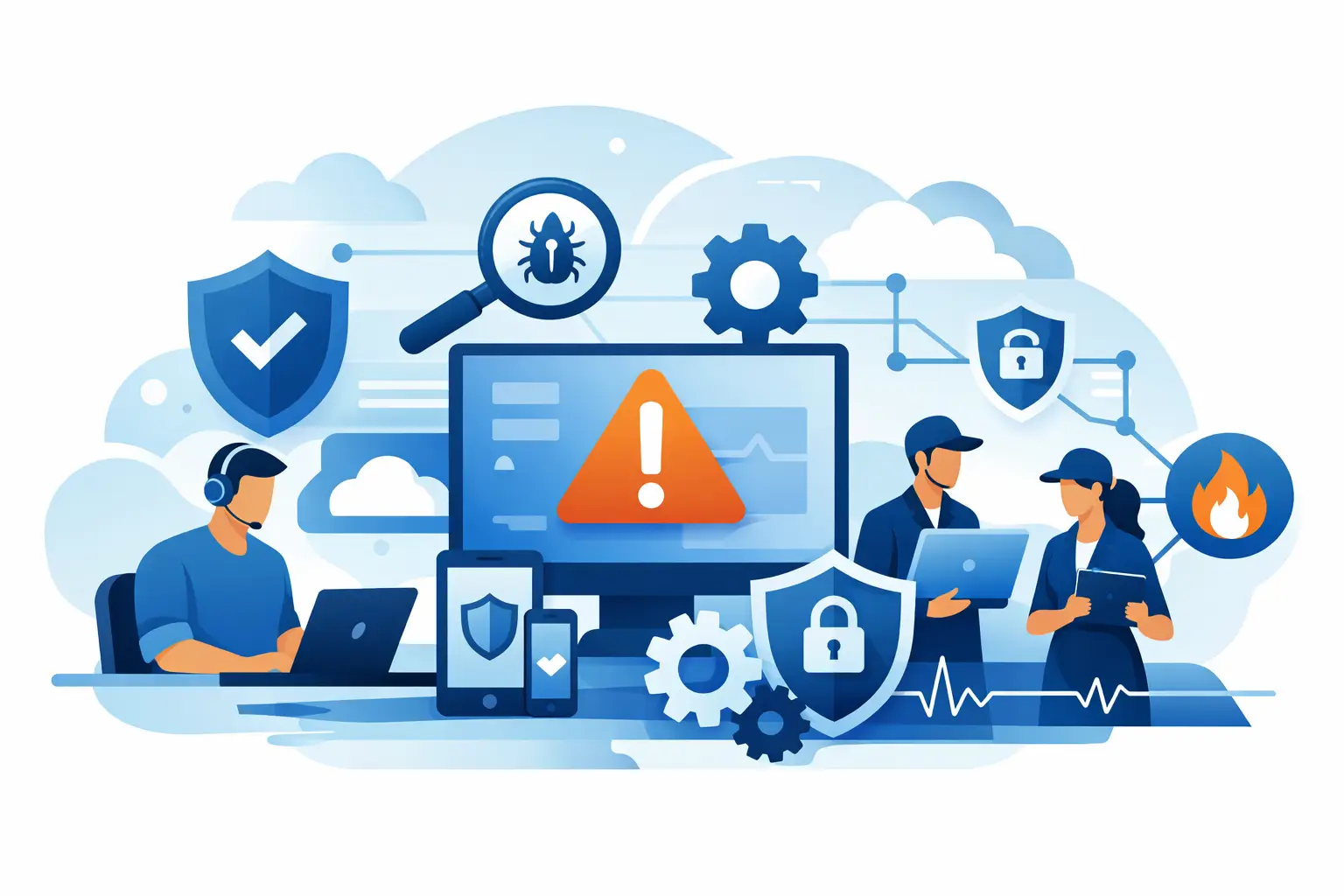
The phone rings at 2:13 a.m. A customer has ransomware indicators across multiple endpoints, their backup job failed three days ago, and the on-call technician is staring at alerts that do not explain the blast radius. This is the moment an incident response retainer for MSPs earns its keep. Not because it magically prevents every breach, but because it replaces improvisation with an agreed path to senior technical help, containment, recovery, and clear customer communication.
For an MSP, an incident is never just a security event. It is a test of customer trust, operational maturity, contract boundaries, and the team’s ability to act under pressure. The wrong response can turn a contained compromise into prolonged downtime, lost data, regulatory exposure, and a client relationship that will not recover as easily as the environment.
Why Incident Response Is a Channel Problem
Most MSPs have capable service desks, solid monitoring, and documented escalation paths for everyday operational issues. A true security incident asks for a different level of coordination. It can require endpoint telemetry analysis, identity investigation, forensic preservation, network isolation, cloud log review, restoration planning, legal and insurance coordination, and executive-level updates – often at the same time.
Building all of that depth internally is expensive. More importantly, it is difficult to keep specialized responders current and available while maintaining a profitable managed services operation. Hiring one strong security engineer does not create a 24/7 incident response function. Incidents rarely respect job descriptions, vacation schedules, or the tidy edges of a single technology stack.
That is why a retainer is not simply prepaid emergency labor. It is a net under the wire. It gives the MSP a defined way to bring in experienced responders while preserving ownership of the client relationship and, when needed, delivering support under the MSP’s brand.
The value is especially clear for partners supporting mid-market and enterprise customers. Those environments often blend on-premises infrastructure, multiple cloud tenants, SaaS applications, legacy identity systems, and third-party integrations. An attacker only needs one overlooked path. The response team needs enough engineering range to understand how those paths connect.
What an Incident Response Retainer for MSPs Should Include
A good retainer should make the first hour calmer, not more confusing. That begins before an incident occurs. The provider and MSP should agree on who can declare an incident, who can authorize isolation actions, how after-hours escalation works, and what information is required to start an investigation.
The retainer should also establish the practical details that tend to slow response: secure communication channels, access methods, key contacts, environment documentation, log sources, backup platforms, and any customer-specific compliance requirements. If responders must spend the first six hours finding tenant administrators or negotiating access, the clock is already working against everyone.
Defined Response Scope and Senior Access
Look for a structure that provides access to senior engineers and incident leadership, not a generic queue with a security label attached. The team should be able to assess whether the event involves malware, compromised credentials, malicious persistence, cloud account abuse, data exfiltration, or an outage that only looks like an attack.
Scope matters, too. A retainer may cover readiness planning, initial triage, containment support, investigation, recovery guidance, and post-incident recommendations. It may not include every hour of a large-scale forensic investigation, legal counsel, breach notification, or replacement hardware. Those exclusions are not a flaw if they are explicit. Vague scope is the flaw.
For channel partners, brand handling belongs in the scope discussion. Decide whether the response team joins customer calls directly, operates behind the scenes, or supports a blended model. White-label delivery should be operationally real, not a logo pasted on a slide deck. The responder needs to understand the MSP’s communication standards, escalation authority, and role in the account.
Readiness Work Before the Alarm
The best incident response hours are the ones spent before an incident. A readiness review can identify whether endpoint detection is actually deployed everywhere, whether logs are retained long enough to investigate, whether privileged access is protected, and whether backups can be restored into a clean environment.
This work maps directly to PRISM thinking. Security controls must be usable in the real environment. Resilience requires recovery capabilities that have been tested, not merely purchased. Performance and migration decisions can introduce hidden dependencies that matter during containment. Innovation should not outpace identity, network, and data protections.
A retainer partner should help the MSP turn these findings into practical priorities. No one needs a 90-page assessment that collects dust. They need a short, ranked plan that closes the gaps most likely to increase incident impact.
The First 24 Hours: What Good Looks Like
During the early response window, speed matters, but uncoordinated speed creates its own damage. Isolating every server, resetting every password, or deleting suspicious artifacts without preserving evidence can disrupt operations and complicate the investigation.
A disciplined response usually moves through three connected decisions: validate what happened, contain what is actively harmful, and preserve enough evidence to understand scope and prevent recurrence. The exact order depends on the threat. If ransomware encryption is spreading, containment takes priority. If a suspected identity compromise has uncertain impact, the team may need rapid log review before making broad changes that alert an attacker or lock out critical service accounts.
The MSP should not be left translating technical findings alone. Good responders provide an executive-ready view of the situation: what is known, what is suspected, what actions have been taken, what business services are affected, and what decisions are needed next. That clarity protects the customer relationship as much as the technical work does.
It also keeps the response from becoming theater. A flurry of chat messages and screenshots is not an incident command structure. The customer needs accountable owners, an action log, a decision cadence, and realistic recovery expectations.
Retainer Models: Capacity, Priority, and Trade-Offs
There is no single retainer model that fits every MSP. A smaller provider with a concentrated customer base may need a modest bank of annual hours, a readiness workshop, and guaranteed escalation. A larger MSSP supporting regulated customers may need 24/7 response commitments, recurring tabletop exercises, and reserved specialist capacity.
The key distinction is between access and availability. Many firms can offer incident response services. Fewer can commit to a meaningful response window when several organizations are experiencing the same widespread threat. Ask how priority is determined, whether capacity is reserved, how response times are measured, and what happens after included hours are consumed.
Price should be considered alongside operational fit. The lowest-cost retainer may provide limited availability or junior triage. The broadest option may be wasteful if the MSP has strong internal security operations and only needs escalation coverage for complex cases. Buy for the risk you actually carry: customer size, technology complexity, compliance obligations, existing security controls, and the financial cost of a delayed response.
Questions MSP Leaders Should Settle Now
Before selecting a partner, get direct answers to the issues that become painful during an active incident:
- Who answers the initial escalation, and what seniority level is involved?
- Can the team support endpoint, identity, network, cloud, and recovery work without passing the case between disconnected vendors?
- How will the provider operate under the MSP’s brand and protect the customer relationship?
- What readiness activities, response hours, and after-hours commitments are included?
- What evidence handling, reporting, and post-incident improvement support will be provided?
Also test the provider’s engineering posture. Incident response is not only about identifying malicious activity. Customers need to rebuild safely, restore services in the right sequence, harden identity controls, validate backups, and address the conditions that allowed the incident to spread. A responder who can find the problem but cannot help stabilize the environment leaves the hardest work on your team.
Make the Retainer Part of the Operating Model
A retainer sitting in a procurement folder is not preparedness. Add it to the MSP’s service delivery playbooks. Train the service desk on escalation triggers. Run a tabletop exercise with the response partner and at least one realistic customer scenario. Confirm contact information quarterly and review major customer architecture changes after migrations, acquisitions, or security platform changes.
This is where a white-label engineering partner can provide real leverage. Mavenspire supports channel teams with senior technical muscle across security, recovery, infrastructure, cloud, and identity, so the response does not stop at a containment recommendation. The goal is drama-free outcomes: protect the client, restore operations, and give the MSP a stronger story to tell when the crisis is over.
Breaches are inevitable enough that hope is not a strategy. An incident response retainer gives your team a practiced path from alarm to action – and gives your customers a reason to believe they chose the right MSP before the next 2:13 a.m. call arrives.