


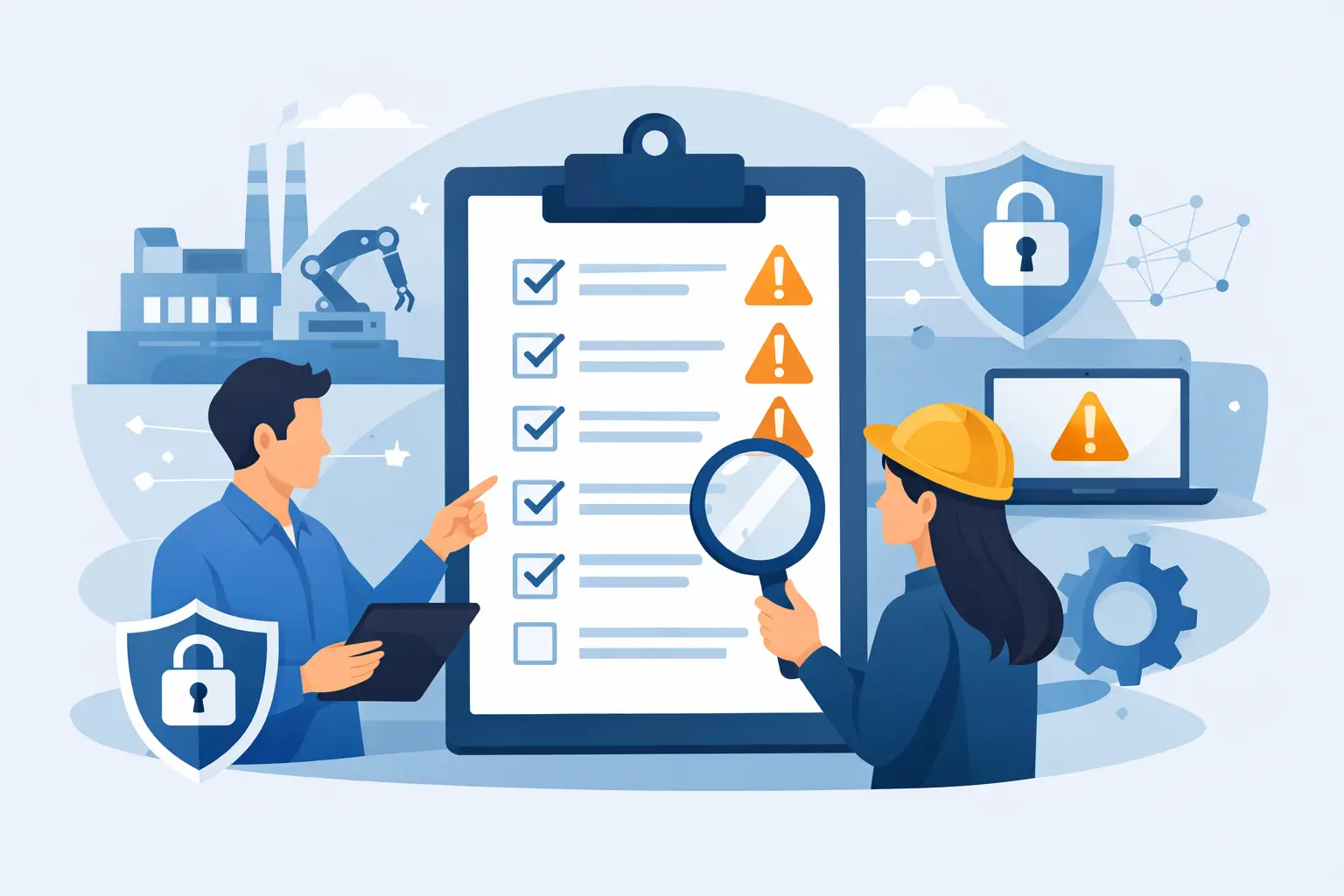
An OT risk assessment checklist is only useful if it reflects how the plant actually runs. That means more than listing assets and checking for patches. In operational technology, a missed dependency can stop a line, trigger a safety issue, or leave a remote site blind when you need visibility most. If you support clients with industrial environments, utilities, building systems, or other cyber-physical operations, the checklist has to account for uptime, safety, and the reality that many OT environments were never designed for modern threat models.
Why an OT risk assessment checklist needs to be different
IT teams are trained to think in terms of confidentiality, standardization, and change velocity. OT teams live in a different world. Availability comes first. Safety is non-negotiable. Stability often matters more than feature depth, and the cost of a bad change can be immediate and physical.
That is why a generic cybersecurity assessment usually falls short. It may flag unsupported operating systems or weak authentication, but it often misses the operational context. A Windows box in accounting and a Windows box tied to a human-machine interface are not the same risk. The same vulnerability can have very different consequences depending on whether it affects a historian, a PLC engineering workstation, or a remote access jump host.
For MSPs, MSSPs, SIs, and VARs, this matters because your client expects two things at once – stronger security and no disruption to operations. That tension is where weak assessments fail. A good checklist helps you prioritize what to fix first, what to monitor closely, and what to leave alone until there is a safe maintenance window.
The OT risk assessment checklist: what to evaluate first
Start with asset visibility. If you cannot identify the systems that run operations, you are guessing. Document controllers, HMIs, historians, supervisory systems, engineering workstations, network infrastructure, remote access paths, vendor-connected systems, and any supporting Windows or Linux hosts that OT depends on. Include make, model, firmware, software version, location, owner, and operational function.
Then map criticality. Not every OT asset deserves the same response. Ask what happens if the asset fails, is manipulated, or becomes unavailable. Some systems create production loss. Others create safety exposure or environmental risk. Some only affect reporting. This is where the checklist becomes useful instead of academic.
Next, review network architecture. Flat OT networks are still common, especially in older environments or sites that expanded over time. Look for segmentation between IT and OT, segmentation within OT zones, firewall rule quality, unmanaged switches, insecure wireless bridges, and undocumented external connections. A checklist should also ask whether traffic flows match the intended design, not just the diagram in a slide deck.
Remote access deserves its own review. In many OT incidents, remote connectivity is the weak point, not the controller itself. Assess who has access, how they authenticate, whether sessions are logged, whether vendors share credentials, and whether access is always on or time-bound. If a third party can reach production systems through a poorly controlled path, that is not convenience. It is exposure.
Security controls that matter in OT
Authentication and account management are often inconsistent in OT. Shared accounts may be common. Default passwords may still exist on embedded devices. Local admin rights may be widespread because the system was built for ease of support, not least privilege. Your checklist should identify all three because each one expands blast radius during an incident.
Patch management needs a reality check. In OT, the right question is not simply whether systems are fully patched. It is whether vulnerabilities are understood, compensating controls are in place, and updates are tested before deployment. Some devices cannot be patched quickly, and some cannot be patched at all without vendor coordination. No excuses, but also no reckless change windows. The checklist should capture patch status, vendor support requirements, known exploitable weaknesses, and interim controls like segmentation, allowlisting, or restricted access.
Endpoint protection is another area where IT assumptions can backfire. Traditional agents may not be supported on industrial systems or may interfere with operations. Instead of forcing a standard toolset where it does not belong, document what is in place and whether it is fit for purpose. That might include passive monitoring, application control, file integrity monitoring, or tightly managed jump hosts.
Logging and detection are often weak in OT, especially at smaller or distributed sites. Determine whether security events, configuration changes, remote sessions, and network anomalies are actually visible to defenders. If logs exist but nobody reviews them, the control is incomplete. If alerts are routed to an IT SOC that does not understand OT protocols or asset roles, detection quality may still be poor.
Process and operational checks most teams miss
A strong OT risk assessment checklist goes beyond devices and networks. It should test the operating model behind the environment.
Start with change management. Ask how control system changes are approved, tested, documented, and rolled back. In mature environments, even small modifications have traceability. In weaker ones, knowledge lives with one engineer and nowhere else. That creates both resilience risk and security risk.
Review backup and recovery next. Many teams say they have backups. Fewer can prove they can restore controller logic, HMI configurations, historian data, and supporting server images within a realistic outage window. Recovery in OT is not just a storage problem. It is a process problem. The checklist should ask whether restores are tested, whether golden configurations exist, and whether recovery steps are documented for the people who will actually execute them.
Incident response is another gap. Most organizations have some kind of cyber incident plan, but OT-specific procedures are often vague. Who decides whether to isolate a system? Who owns communication with plant leadership? What happens if containment steps impact safety or production? The checklist should validate not just whether a plan exists, but whether it reflects plant operations, vendor dependencies, and real escalation paths.
Physical security also belongs on the list. Control cabinets, field devices, networking closets, and engineering stations are often easier to reach than the security team assumes. If unauthorized personnel can plug into a switch, access an open cabinet, or walk off with a laptop used for PLC programming, cyber risk is already physical risk.
How to prioritize findings without causing chaos
The point of an assessment is not to produce a thick report. It is to make better operational decisions. That requires prioritization tied to consequence.
A practical scoring model looks at three factors: impact to safety and operations, likelihood of exploitation or failure, and ease of remediation. A high-severity software flaw on an isolated low-value system may rank below weak vendor remote access into a critical production segment. Context changes priority.
This is also where trade-offs show up. You may find unsupported systems that are too risky to patch in the short term. You may identify a segmentation gap that is expensive to fix cleanly. You may discover that the safest immediate step is stronger monitoring and tighter access control while a larger remediation plan is developed. That is not avoiding the problem. It is sequencing the work so the client gets safer without breaking production.
For service providers, this is where credibility is won or lost. Clients do not need recycled control-framework language. They need a plan that separates urgent actions from longer-term engineering work and makes clear who owns each step.
A workable OT risk assessment checklist in practice
In the field, the most effective checklist usually covers six areas: asset inventory and criticality, network architecture and segmentation, identity and remote access, vulnerability and patch exposure, backup and recovery readiness, and incident response with operational accountability. Those categories are broad enough to capture the real environment but focused enough to drive action.
What matters most is evidence. Do not accept assumptions, outdated diagrams, or verbal confirmation as proof. Validate configuration samples, review access logs, inspect firewall rules, and walk the environment with the people who run it. Diagnostics and discovery first is not a slogan. In OT, it is how you avoid making bad recommendations based on incomplete facts.
If you are supporting clients across multiple sites, standardize the checklist structure but allow for site-level differences. A water facility, a manufacturing plant, and a distribution center may all use OT, but the risk model is not identical. The checklist should be repeatable without becoming blind to context.
Good OT assessments are built by doers, not just talkers. They recognize that the right answer is sometimes stronger security controls, sometimes better operational discipline, and often both at once. If the checklist helps your team expose the real risks, assign the right priority, and move from findings to execution, it is doing its job. The best next step is simple: assess what is actually there, not what everyone hopes is there.