


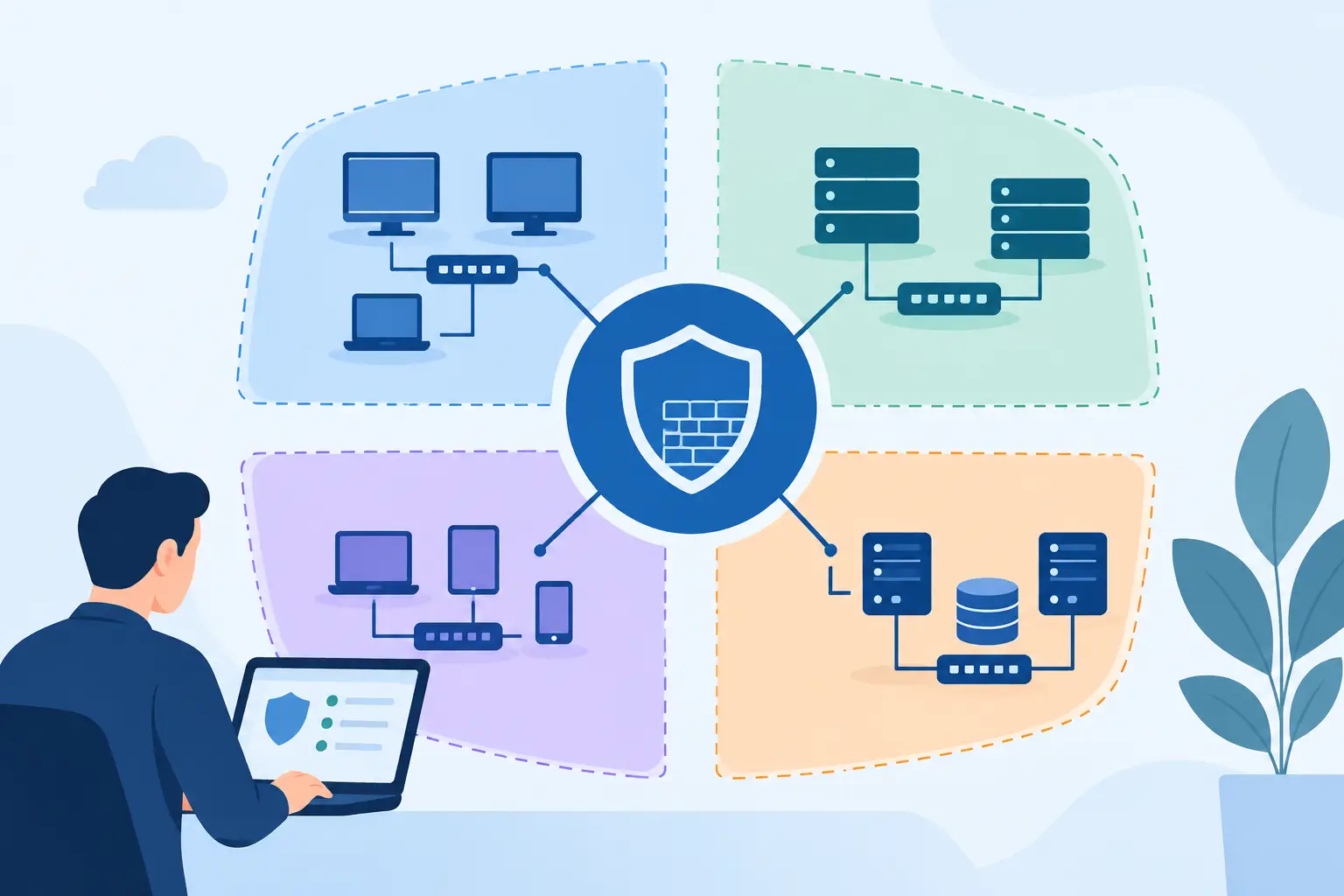
A flat network is a gift-wrapped lateral-movement path. One compromised endpoint, service account, or vendor connection can become a route to domain controllers, production workloads, backups, or operational technology. This network segmentation implementation guide is built for teams that need to reduce that blast radius without creating an outage factory.
For MSPs, MSSPs, VARs, and SIs, the challenge is rarely finding a firewall feature. The hard part is designing controls that match how the customer actually operates, then implementing them without breaking the applications and relationships that keep the business running. Good segmentation is not a diagram with colored boxes. It is enforceable policy, validated traffic flows, accountable owners, and a recovery plan when a rule behaves badly.
Start With the Risk You Need to Contain
Segmentation projects stall when they begin with technology instead of a business outcome. Start by asking what must not be reachable from a compromised user device, guest network, third party, or cloud workload. For many organizations, the first protection targets are identity systems, backup platforms, payment environments, sensitive data stores, production servers, and OT assets.
This does not mean every asset needs its own segment on day one. Over-segmentation can create a brittle environment that is expensive to troubleshoot and easy for operations to bypass. The right level depends on the environment’s risk, application dependency complexity, regulatory obligations, and available operational maturity.
A practical early objective might be simple: user and guest networks cannot directly reach server management interfaces; server workloads can only reach the services they require; and backup infrastructure accepts connections from approved backup systems only. Those boundaries materially reduce risk while giving the team a manageable first deployment.
Build an Asset and Dependency Baseline
You cannot segment what you cannot see. Create an inventory that connects assets to function, owner, location, identity source, sensitivity, and dependencies. Pull from CMDB records, vulnerability scanners, EDR, DHCP, cloud inventories, switch tables, firewall logs, and application owners. None of these sources is perfect. Together, they are usually good enough to expose the gaps that matter.
Traffic analysis deserves special attention. A server may look quiet until month-end processing begins. A manufacturing system may rely on a protocol that appears only during a maintenance window. Collect flow data long enough to capture normal operations, scheduled jobs, patching, backup cycles, and known peak periods.
Document each required flow in plain terms: source, destination, protocol, port, purpose, owner, and whether it is permanent, temporary, or exception-based. If nobody can explain why a flow exists, do not automatically block it. Mark it for investigation, assign an owner, and give it an expiration decision. Mystery traffic has a way of becoming emergency traffic at the worst possible moment.
Design Zones Around Trust, Not Topology
The most useful segmentation design groups systems by trust level and operational purpose. Network location alone is not enough. Two virtual machines on the same host may have very different risk profiles, and a cloud workload can be just as exposed as an on-premises server.
A common model separates user devices, shared services, production applications, management systems, backups, development environments, guest and IoT devices, third-party access, and OT systems. These are not mandatory labels. They are starting points for deciding which conversations are normal and which should be denied by default.
The key principle is least privilege between zones. Permit specific, documented flows. Deny everything else, preferably with logging that security and operations can use. In high-risk areas, such as identity, administrative access, and backups, add stronger controls such as privileged access paths, multifactor authentication, jump hosts, and separate management networks.
Choose the Right Enforcement Point
Segmentation can be enforced through next-generation firewalls, internal firewalls, routing and access-control lists, software-defined networking, cloud security groups, Kubernetes network policies, endpoint controls, or a combination of these. The best answer is usually not one product pasted across every environment.
Physical and virtual firewalls offer strong inspection and centralized policy, but they can add latency or create throughput constraints if sized poorly. ACLs can be fast and effective for simple boundaries, but they are less expressive and may be harder to audit at scale. Cloud-native controls are close to workloads and automate well, but they require disciplined tagging, infrastructure-as-code practices, and clear ownership between cloud and security teams.
For hybrid environments, use consistent policy intent even when enforcement tools differ. “Only the application tier may connect to the database listener” should mean the same thing whether the workload lives in a data center, Azure, AWS, or a branch office. The implementation details can vary. The security outcome should not.
Network Segmentation Implementation Guide: Deploy in Stages
A big-bang cutover is rarely the brave option. It is often the expensive option. Stage implementation so the team can validate assumptions, tune policies, and maintain a clean rollback path.
Begin with a pilot zone that has meaningful value but manageable complexity. A noncritical server group, a new application deployment, or a user-to-management boundary can work well. Build the policy in monitor mode where the platform allows it, review observed flows against the documented dependency map, and resolve exceptions before switching to enforcement.
When moving to enforcement, schedule a defined change window and put the right people on the bridge: network engineering, security operations, application owners, service desk leads, and the customer stakeholder who can make a business decision. Establish success criteria before the change. For example, authorized application traffic succeeds, unauthorized test traffic is blocked, monitoring remains healthy, and rollback can be completed within a stated time.
Treat exceptions as controlled debt, not permanent architecture. Each exception should have an owner, reason, scope, expiration date, and review cycle. A rule that permits “any to any” because someone needed a quick fix is not a segmentation policy. It is a hole with better documentation.
Test the Controls Like an Attacker and an Operator
A successful change ticket does not prove segmentation works. Test the boundaries from both sides. Confirm that required traffic succeeds, prohibited traffic fails, logs identify the blocked attempt, and alerting reaches the team responsible for response.
Run tests for common attacker paths: a standard user endpoint attempting to reach administrative protocols, a compromised server attempting to access backups, a vendor network attempting to scan production systems, or a development workload attempting to reach production data. Then run operational tests: patch deployment, backup and restore, failover, remote support, endpoint management, and scheduled data transfers.
This is where many programs discover that their recovery design is weaker than expected. If ransomware reaches a workload, can administrators reach recovery tools without traversing the compromised zone? Can backup systems be managed through a protected path? Segmentation should support resilience, not create a locked room around the fire extinguisher.
Make Segmentation an Operating Capability
Networks change. New SaaS integrations appear, acquisitions bring unfamiliar infrastructure, developers deploy workloads faster, and vendors request access with varying levels of urgency. A segmentation program that is not operationalized will slowly return to flatness through exceptions and workarounds.
Assign ownership for policy approval, rule implementation, monitoring, and periodic recertification. Connect segmentation changes to the existing change-management process, but do not bury urgent security decisions in a weeks-long queue. Define an emergency workflow with post-change review so the business can keep moving without losing accountability.
Measure outcomes that leadership and delivery teams can use: number of critical assets isolated, percentage of rules with documented owners, exception aging, blocked lateral-movement attempts, time to approve legitimate access, and failed-change rates. These metrics reveal whether the program is reducing risk or simply generating more tickets.
For channel partners, this operational layer is where senior engineering depth matters. Mavenspire can provide white-label technical muscle for assessment, architecture, implementation, validation, and ongoing improvement while the partner retains the customer relationship. That is a net under the wire when the project is too complex, too urgent, or too consequential for a thin bench.
Segmentation is never fully finished, and that is fine. Build the next boundary based on the next meaningful risk, validate it against real operations, and keep tightening the paths an attacker would need. Drama-free outcomes come from doing the hard engineering before the incident turns every unknown dependency into a crisis.