


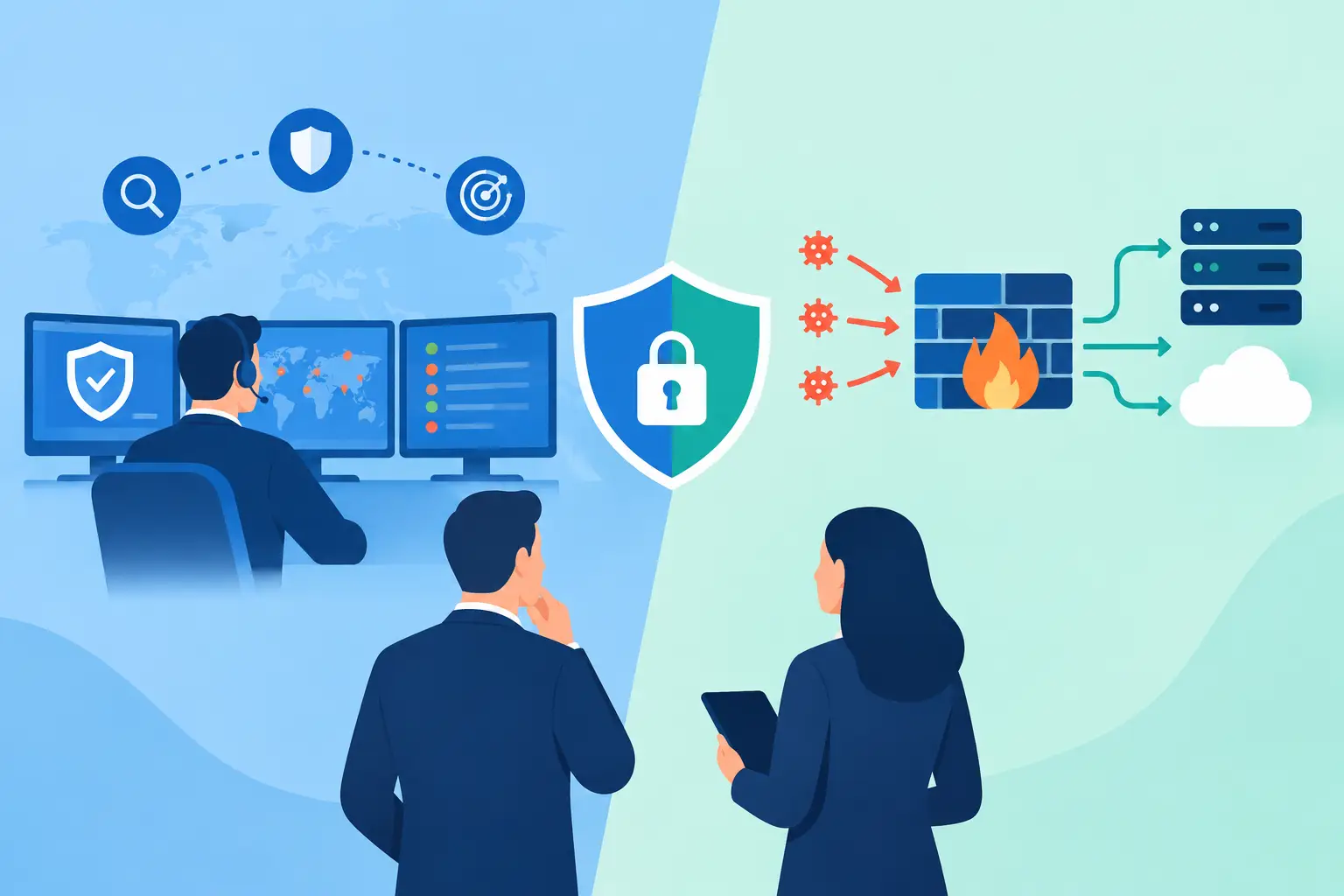
A firewall alert at 2:13 a.m. is not a security outcome. Neither is a dashboard full of green checkmarks after a credential theft campaign has already moved through Microsoft 365, endpoints, and cloud workloads. The real MDR vs managed firewall question is not which service is better. It is which layer is responsible for seeing the threat, containing it, and proving the work got done.
For MSPs, MSSPs, VARs, and SIs, that distinction matters even more. Customers often ask for a “managed firewall” when what they really need is coverage across identities, endpoints, email, cloud applications, and the network. Give them only what they asked for without clarifying the gap, and someone eventually gets a very expensive lesson in scope.
MDR vs Managed Firewall: Different Jobs, Different Visibility
Managed detection and response, or MDR, is a security operations service. It collects and analyzes telemetry from security tools, detects suspicious activity, investigates it, and takes or recommends response actions. The telemetry commonly comes from endpoint detection and response platforms, identity providers, email security, cloud platforms, security information and event management systems, and sometimes network sensors.
A managed firewall service is primarily a network security operations service. The provider manages the firewall platform, including policy changes, software updates, rule reviews, VPN configuration, high-availability health, log monitoring, and sometimes threat prevention features. It protects and controls traffic that crosses the network boundary or moves between segmented zones.
Both services reduce operational burden. Both can be valuable recurring offerings. But they are not interchangeable. A managed firewall can enforce a policy with precision. MDR can investigate whether an attacker is already operating inside the environment despite that policy.
What a managed firewall is built to do
A managed firewall is strongest when the work is network-centric. Think branch connectivity, remote access, site-to-site tunnels, segmentation, egress controls, application filtering, intrusion prevention, and change control. A capable team can keep rules from turning into a decades-old junk drawer, identify risky exposures, and make sure the appliance is patched and functioning when it counts.
That is no small thing. Poorly managed firewall rules create attack paths, outages, and audit findings. An open remote management port, an overly broad allow rule, or a forgotten vendor VPN can become the net under the wire for an attacker.
Still, a firewall sees only the traffic and events available to it. If a user signs into a legitimate SaaS application with stolen credentials, the firewall may have little meaningful context. If malware runs from a compromised endpoint and uses encrypted web traffic, the firewall may block it, log it, or miss the full story depending on its inspection capabilities and configuration.
What MDR is built to do
MDR is designed for detection, investigation, and response across the attack lifecycle. A mature MDR team looks for behavior rather than waiting only for a known malicious IP address or signature. It can correlate an impossible-travel sign-in with an endpoint process, a new mailbox forwarding rule, and unusual cloud activity. That is how isolated events become an incident worth acting on.
The response component is the differentiator. Depending on the service and customer authorization, MDR analysts may isolate an endpoint, disable a user account, terminate a malicious process, block an indicator, or escalate with clear remediation instructions. The quality of that response model matters more than a glossy portal. A ticket that arrives six hours after ransomware encryption begins is documentation, not defense.
MDR does have dependencies. It needs quality telemetry, correct tool deployment, well-defined escalation contacts, and authority to act. If the endpoint agent is missing from servers, identity logs are unavailable, or the provider cannot contain a confirmed threat without three approval layers, response time suffers.
The Operational Difference at a Glance
| Area | Managed Firewall | MDR | | — | — | — | | Primary focus | Network policy and perimeter or segmentation controls | Threat detection, investigation, and response | | Main telemetry | Firewall logs, traffic, VPN, intrusion prevention, DNS, and network events | Endpoint, identity, email, cloud, SIEM, and often network telemetry | | Typical actions | Change rules, block traffic, patch devices, manage VPNs, tune policies | Investigate alerts, isolate hosts, disable accounts, contain threats, guide recovery | | Best answer to | “Is network access controlled and maintained?” | “Is someone attacking us, and what are we doing about it?” | | Common limitation | Limited visibility beyond the network control point | Depends on coverage, integrations, and response authority |
The table is useful, but the reality is messier. Some firewall providers offer 24/7 SOC monitoring. Some MDR providers ingest firewall logs and can request or execute network blocks. Service labels are not a substitute for a scope review. Ask what telemetry is collected, who watches it after hours, what actions are included, and what happens when a real incident is confirmed.
Where Managed Firewall Alone Can Fall Short
A managed firewall remains a foundational control, especially for distributed organizations, regulated environments, and businesses with on-premises infrastructure. But the perimeter is no longer where the entire fight happens. Users, identities, SaaS platforms, cloud workloads, and unmanaged devices have stretched the traditional edge in every direction.
Consider a business email compromise scenario. An attacker obtains a finance employee’s credentials through phishing, signs in from a legitimate browser, creates inbox rules, and monitors payment conversations. A well-run firewall may never see enough evidence to stop it. MDR with identity and email telemetry has a much better chance of identifying the unusual sign-in, persistence behavior, and fraudulent activity.
The reverse is also true. An MDR service cannot replace disciplined firewall engineering. If the customer has flat network segments, overly permissive outbound access, unsupported appliances, or remote access exposed without sound controls, the environment is easier to compromise and harder to contain. Detection without enforceable controls becomes an exhausting game of cleanup.
Choosing the Right Service for the Customer
Start with the customer’s operational risk, not the product catalog. A small professional services firm with cloud-first operations and little on-premises infrastructure may need MDR, identity protection, email security, and endpoint coverage before it needs an elaborate managed firewall program. A manufacturer with multiple sites, industrial networks, remote vendors, and legacy systems may need firewall management and segmentation engineering as an immediate priority, alongside monitoring tailored to OT realities.
Managed firewall is often the right first conversation when the customer needs reliable network operations, formal change management, secure site connectivity, and policy hygiene. It is also a practical entry point for channel partners building recurring security services around installed firewall estates.
MDR should move to the front when the customer lacks 24/7 security coverage, has frequent endpoint or identity alerts, carries cyber insurance and compliance obligations, or needs someone prepared to investigate and contain threats after business hours. It is particularly relevant where ransomware, account takeover, and cloud misuse would create material downtime or financial loss.
Budget matters, but buying the cheaper service to solve the wrong problem is not savings. A firewall management agreement may cost less than MDR because it has a narrower operational mandate. That can be a sensible decision if the client understands what is not included. Clear boundaries protect both the customer and the provider relationship.
Build the Security Stack Around Response, Not Tools
The strongest model is usually not MDR or managed firewall. It is MDR plus managed firewall, supported by the controls that make both services effective. Endpoint coverage, multifactor authentication, identity hardening, secure email, tested backups, segmentation, vulnerability management, and an incident response plan all have a role.
For channel partners, the delivery model needs the same discipline. Define ownership for alert triage, firewall changes, emergency containment, customer communication, evidence retention, and recovery. Establish service-level expectations that distinguish a standard change request from an active incident. Then test the handoffs. A runbook that has never met a real incident is just optimistic paperwork.
This is where senior engineering depth earns its keep. Mavenspire helps partners add white-label technical muscle across architecture, implementation, managed security, incident response, and recovery without handing the customer relationship to a stranger. The goal is not vendor sprawl or security theater. It is a service design that can detect trouble, enforce controls, and recover when prevention is not enough.
Ask Better Questions Before You Sell
Before positioning either service, ask the customer what they need protected, what logs exist, who is on call, and who has authority to contain an incident. Ask whether their firewall policies have been reviewed, whether endpoint protection covers every critical system, and whether identity events are monitored. Then ask the uncomfortable question: if a user account is compromised on a Saturday, who can disable it within minutes?
That answer usually makes the MDR vs managed firewall decision clearer. A firewall is a critical gatekeeper. MDR is the team watching for the attacker who found another way in. Build for both realities, and the customer gets something far more useful than another security SKU: a defense operation that can take a hit and keep moving.