
If your team is spending more time chasing outages, patching around old systems, and arguing with vendors than moving the business forward, the problem usually is not effort. It is coverage. Managed IT infrastructure services exist for exactly this gap – when the environment is too critical, too complex, or simply too understaffed to run well on reactive support alone.
For many organizations, infrastructure has become a mix of legacy hardware, cloud platforms, remote endpoints, security controls, backups, identity tools, and business-critical applications that all depend on each other. One weak link can create downtime, security exposure, or performance issues that ripple across the business. The question is not whether you need infrastructure support. The real question is how much of it should be owned internally, how much should be engineered externally, and who is accountable when things go sideways.
What managed IT infrastructure services actually cover
This is where a lot of buyers get vague answers. Some providers treat managed services like a help desk plus monitoring. That is not enough for a complex environment.
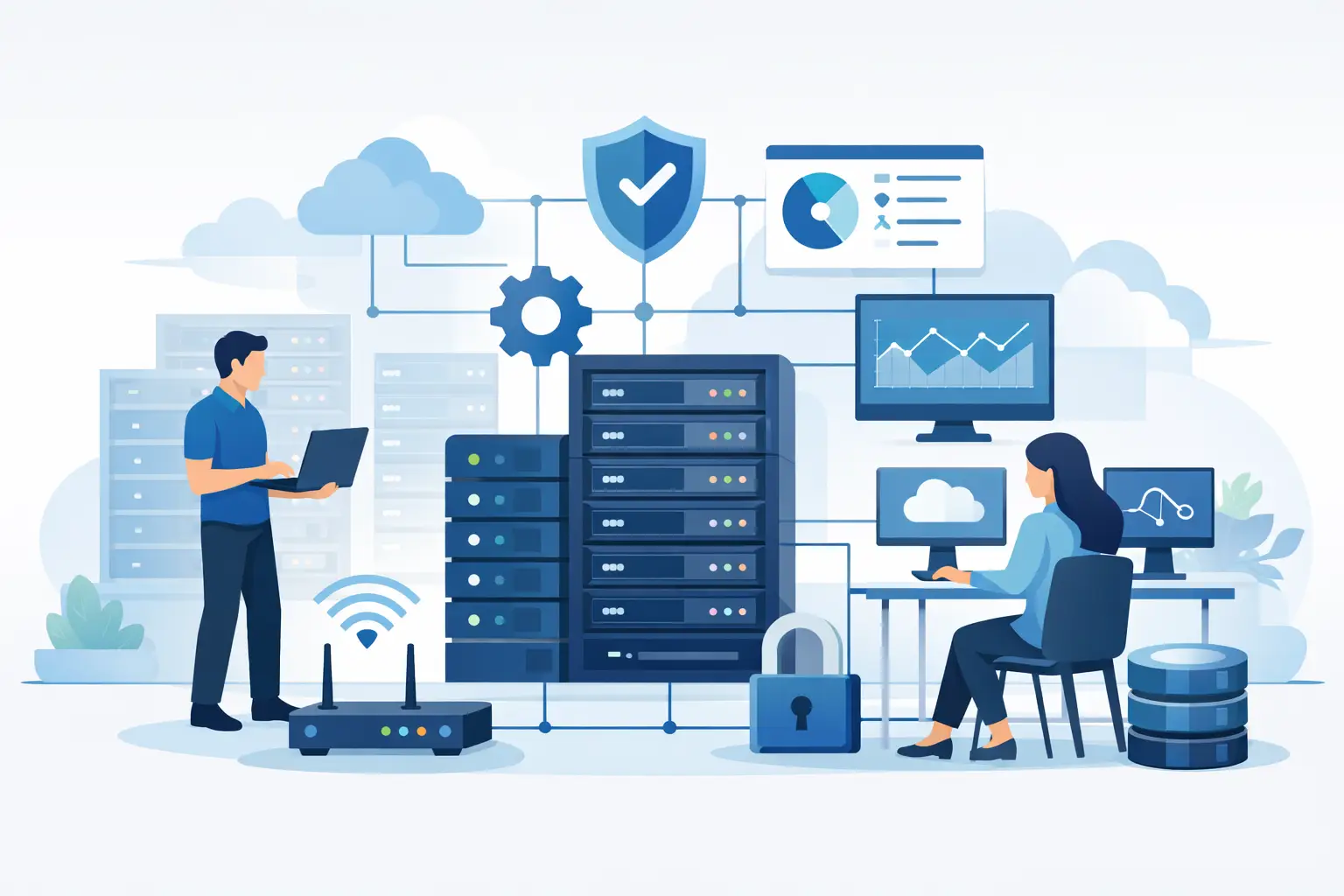
Managed IT infrastructure services should cover the systems that keep your business running day to day. That often includes servers, storage, network infrastructure, firewalls, cloud resources, endpoint management, identity and access controls, backup platforms, disaster recovery systems, patching, performance monitoring, and operational support. In stronger service models, it also includes capacity planning, security hardening, documentation, standards enforcement, lifecycle management, and escalation engineering when the issue is deeper than an alert.
The difference matters. Monitoring by itself only tells you something is broken. Managed service should mean someone owns the response, the remediation path, and the prevention plan.
Why companies turn to managed IT infrastructure services
Most organizations do not make this move because it sounds efficient on paper. They make it because internal teams are overloaded and the environment is getting harder to control.
A mid-market IT director may have solid generalists but no deep bench for cloud networking, backup architecture, or zero trust access. An operations leader may be dealing with plant systems, remote sites, aging switches, and compliance demands at the same time. A security leader may know the infrastructure has drifted over time and now carries more risk than anyone wants to admit. In each case, the issue is not a lack of smart people. It is a lack of time, specialized expertise, and operational redundancy.
That is where managed infrastructure support earns its keep. The right partner gives you engineering depth without forcing you to hire for every niche role. It also creates consistency. Systems get monitored the same way, patched on schedule, documented properly, and reviewed before small issues turn into expensive incidents.
There is also a business reality here. Downtime, failed backups, slow systems, and misconfigured cloud resources are not just technical problems. They affect revenue, customer trust, compliance posture, and the ability to execute larger initiatives. If your infrastructure team is stuck in firefighting mode, modernization usually stalls.
The real value is not outsourcing – it is operational control
Some leaders resist managed services because they hear the word outsourcing and assume loss of control. Fair concern. It happens when the provider works like a black box.
The better model is shared control with clear ownership. Your business keeps decision rights, priorities, and visibility. The managed services team brings process, engineering discipline, coverage, and execution. That means better runbooks, cleaner escalation paths, stronger change management, and fewer surprises.
This is also why service design matters more than sales language. If a provider cannot tell you who handles incidents, how changes are approved, what gets reported monthly, what is included in proactive maintenance, and when senior engineers get involved, keep looking.
A good managed service relationship should make your internal team stronger, not sidelined. It should remove repetitive operational burden so your people can focus on architecture, business alignment, and strategic projects.
Where managed infrastructure services fit best
Not every company needs the same level of support. It depends on complexity, risk, and internal capability.
If your environment spans on-prem systems and multiple cloud platforms, managed support can help create consistent operational standards. If you are in a regulated industry, it can help close gaps in logging, access control, backup validation, and recovery readiness. If you are growing fast, it can provide structure before infrastructure debt piles up. If you are dealing with repeated instability, it can stabilize the core before bigger transformation work starts.
There are also cases where fully managed is not the right fit. Some enterprise teams want a co-managed model where internal staff retain direct control over key systems and the provider fills after-hours coverage, specialized engineering, or defined operational functions. That can be the smarter move when you already have strong internal leadership but need more hands and deeper expertise.
It depends on your operating model. The point is not to hand everything away. The point is to close the execution gap without creating new friction.
What good managed IT infrastructure services look like in practice
A strong provider starts with the environment as it really is, not as the diagram says it is. That means assessment first. What assets are in scope, what dependencies exist, where are the failure points, what is undocumented, what is nearing end of life, and what risk has been normalized because the team has learned to work around it?
From there, the service should move into structured support. Monitoring gets tuned so your team is not buried in noise. Patch management gets aligned to risk and business windows. Backup jobs are not just scheduled but tested. Capacity and performance are reviewed before systems hit a wall. Security baselines are enforced. Escalations route to people who can actually fix the issue.
This is also where engineering-led providers stand apart. Plenty of firms can keep the lights on. Fewer can also redesign a brittle network, clean up identity sprawl, rationalize cloud costs, or build a recovery strategy that works under pressure. Infrastructure management should not be disconnected from improvement. The best teams diagnose, solve, and optimize while operations continue.
That is the difference between a ticket processor and a real delivery partner.
How to evaluate a managed infrastructure partner
Start with accountability. Ask what outcomes they own, not just what tools they use. Tools matter, but they do not replace judgment.
Then look at technical depth. Can they support hybrid infrastructure, cloud, security, compliance, and recovery planning as one connected environment? Or will they stop at basic administration and push hard problems elsewhere? If your business depends on uptime, that gap becomes your problem fast.
You should also press on onboarding. Weak onboarding creates months of confusion. Strong onboarding includes discovery, documentation, standards review, access controls, escalation mapping, operational baselines, and a clear transition plan. If they want to start managing your environment before they understand it, that is a red flag.
Reporting is another test. Good reporting should tell you what changed, what failed, what was resolved, what risk remains, and what needs a decision from leadership. If all you get is ticket counts, you are not buying insight. You are buying activity.
Finally, ask how they handle projects that emerge from support. Mature providers can move from assessment to implementation to managed operations without finger-pointing between teams. That matters because infrastructure problems rarely stay in one lane. A backup issue may turn into a storage redesign. A firewall problem may expose broader segmentation weaknesses. A cloud performance complaint may actually be an architecture issue.
This execution-backed model is where firms like Mavenspire have an advantage. The work does not stop at recommendations. The right team can assess the problem, engineer the fix, and stay accountable after go-live.
The trade-offs buyers should be honest about
Managed services are not magic. You still need internal ownership, business alignment, and decision-making discipline. If your leadership team cannot prioritize, if every change is treated like an emergency, or if no one wants to standardize anything, the provider will feel that friction too.
There is also a balance between standardization and customization. Standard processes usually improve reliability and response times. But some environments have operational realities that require exceptions, especially in manufacturing, healthcare, or distributed field operations. A capable provider knows when to enforce consistency and when to adapt.
Cost should be weighed carefully as well. The cheapest contract often delivers the narrowest coverage, the least engineering depth, and the most escalation gaps. On the other hand, not every company needs white-glove everything. The right scope is the one that matches business criticality, compliance pressure, and the maturity of your internal team.
That is why the best buying decision is rarely based on price alone. It is based on whether the service reduces risk, improves uptime, strengthens recovery, and frees your people to work on higher-value priorities.
Managed IT infrastructure services are really about confidence
When infrastructure is unstable, every project feels harder than it should. Cloud initiatives drag. Security programs stall. Teams lose time to avoidable issues. Leadership loses confidence in delivery.
When the foundation is well managed, the business feels it. Systems perform predictably. Risks are visible. Recovery plans are real. Internal teams can focus on progress instead of constant repair.
That is the standard to hold. Not flashy dashboards. Not vague promises. Real operational confidence, backed by people who know how to build, fix, and run the environment with no excuses.