


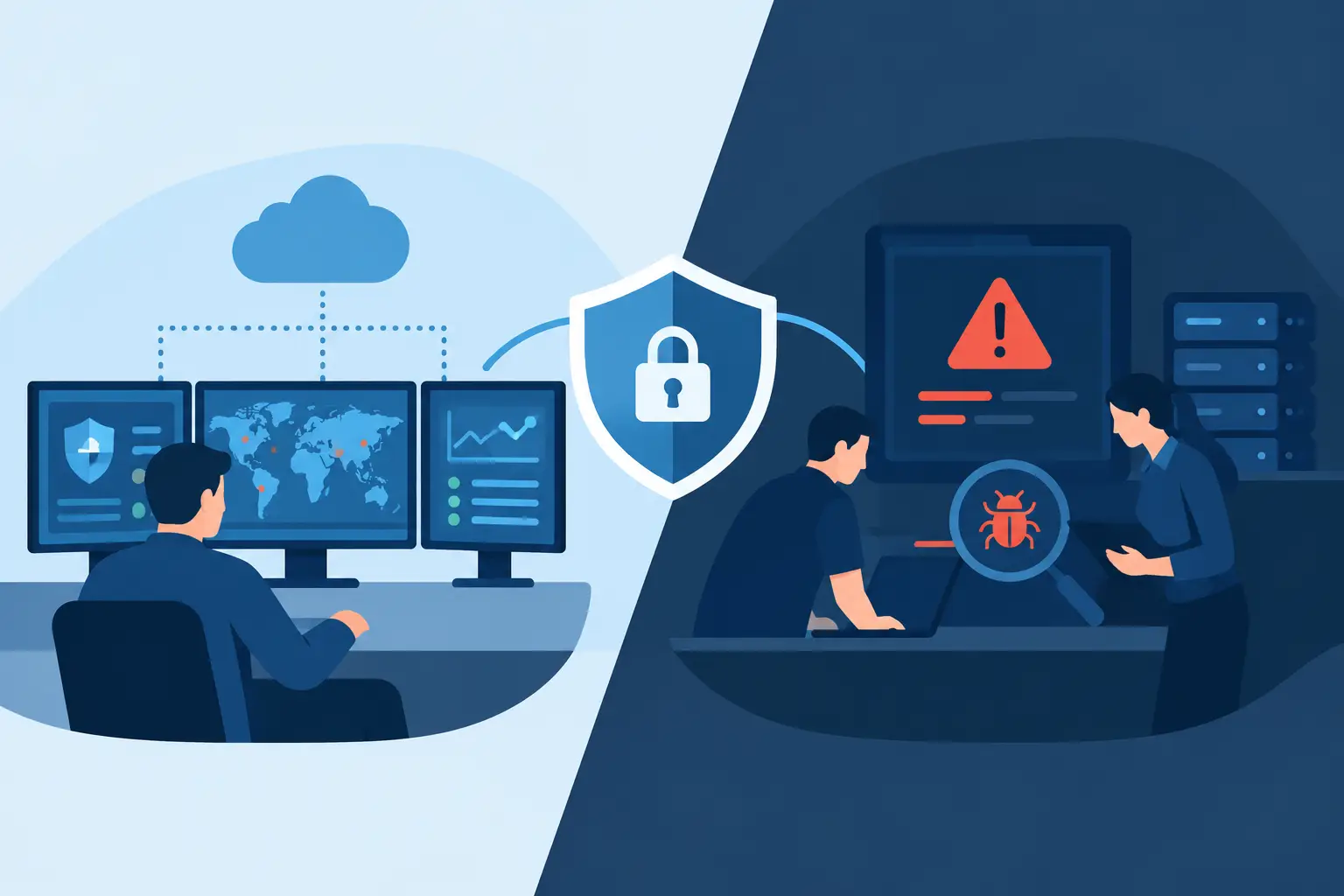
A client does not care whether a compromised identity was caught by a managed detection team or contained by an incident response team. They care that payroll still runs, production stays online, and their board does not receive a call that starts with, “We have a situation.” That is why managed detection vs incident response is not a theoretical service-catalog debate. It is an operating-model decision with direct consequences for customer trust, response time, and service margins.
For MSPs, MSSPs, and technology partners, the distinction matters even more. You need to know where continuous security operations end, where crisis response begins, and whether your delivery model can handle both without exposing your brand or exhausting your team.
Managed Detection vs Incident Response: The Core Difference
Managed detection is an ongoing security capability. Its job is to collect telemetry, identify suspicious activity, validate threats, and initiate response actions before a security event becomes a business-stopping incident. It is the watch floor, the radar, and the early warning system.
Incident response is a focused engagement activated when an incident is confirmed or strongly suspected. Its job is to contain the threat, investigate what happened, eradicate attacker persistence, recover affected systems, and help the organization make defensible decisions under pressure. It is the fire crew and the structural engineer arriving after the alarm proves real.
The services overlap, but they are not interchangeable. A managed detection provider may isolate an endpoint, disable a risky account, or escalate an alert with recommended actions. An incident response team may perform deep forensic analysis, determine the scope of lateral movement, coordinate legal and insurance stakeholders, and rebuild compromised identity infrastructure.
Put plainly: managed detection aims to keep bad days small. Incident response manages the bad day when it has already grown teeth.
What Managed Detection Delivers Day to Day
Managed detection is commonly delivered through a mix of security information and event management, endpoint detection and response, identity telemetry, cloud logs, network signals, and human analysis. The tooling matters, but the operating discipline matters more. A dashboard full of alerts is not a security operation. It is just an expensive way to generate anxiety.
A capable managed detection service establishes baselines, tunes detections, investigates suspicious behavior, prioritizes validated threats, and follows documented escalation paths. The best teams also understand the client environment well enough to separate a strange-but-legitimate administrative action from a genuine sign of compromise.
For a channel partner, managed detection can create recurring value and tighter client relationships. It gives customers around-the-clock visibility without requiring them to hire and retain a full internal security operations center. It also produces useful operational intelligence: recurring identity risks, unpatched assets, risky cloud configurations, and business units that need better controls.
That said, managed detection has limits. It cannot compensate for missing logs, poorly configured endpoint tools, unmanaged privileged accounts, or vague authority to act. If the contract says “notify only,” an analyst can identify ransomware activity quickly and still be unable to stop encryption. Speed without preauthorization is sometimes just fast bad news.
Detection Is Not a Guarantee of Containment
A common mistake is assuming a 24/7 monitoring service means a client is fully prepared for a breach. Monitoring reduces dwell time. It does not automatically establish crisis communications, legal workflows, recovery priorities, forensic preservation procedures, or executive decision rights.
Those details become painfully relevant when an attacker has access to an administrator account, a cloud tenant, backups, or operational technology. Detection may identify the first indicator. Incident response determines how far the problem goes and what must happen next.
What Incident Response Does When the Stakes Rise
Incident response is designed for uncertainty, pressure, and imperfect information. A mature response team starts by stabilizing the environment without destroying evidence or causing an avoidable outage. That balance takes experience. Pulling every system off the network can stop attacker activity, but it can also stop a hospital workflow, warehouse, manufacturing line, or revenue-generating application.
The response typically moves through several connected activities: triage and scoping, containment, evidence preservation, investigation, eradication, recovery, and post-incident improvement. These are not neat boxes checked in sequence. New evidence can change the scope, forcing teams to revisit earlier decisions.
For example, an alert involving a single malicious login may initially appear contained after a password reset. Forensics may later show the attacker registered a rogue authentication method, accessed a mailbox, created forwarding rules, and used the account to target finance staff. The incident response work is not merely resetting the password. It is finding the full path, removing persistence, validating recovery, and documenting what actually occurred.
Incident response also requires leadership. Technical containment decisions affect operations, customer communications, contractual duties, cyber insurance requirements, and regulatory obligations. The right responder brings technical facts to those decisions without pretending that a technical fix alone resolves a business crisis.
Where the Handoff Often Breaks
The dangerous gap is usually not between tools. It is between teams, contracts, and assumptions.
A managed detection analyst sees suspicious activity at 2:13 a.m. Who has authority to isolate the host? Who contacts the client? What happens if the primary contact does not answer? Which systems cannot be disconnected without business approval? Is there an incident response retainer, and does the responder already have access to the required telemetry?
If those answers live in someone’s head, the client does not have a response plan. They have a hope plan.
For service providers, the handoff must be designed before an incident. That means defining severity levels, notification expectations, containment authority, evidence-handling practices, executive escalation routes, and the exact moment an event becomes an incident response engagement. It also means testing the process. A tabletop exercise can expose unclear responsibilities without waiting for ransomware to do the testing for you.
Choose the Model Based on Risk, Not Packaging
Some organizations need managed detection first. This is common when they have limited internal security coverage, too many alerts, inconsistent endpoint visibility, or no practical way to monitor cloud and identity activity after business hours. Continuous detection is the sensible starting point because it provides visibility and reduces the chance that an attacker operates unnoticed for weeks.
Other organizations have monitoring in place but lack confidence in their ability to manage a material compromise. They may need an incident response retainer, a recovery assessment, and a tested crisis playbook. A retainer can reduce friction when time matters, especially if the responder has already reviewed the environment, critical systems, identity architecture, and backup strategy.
Most mid-market and enterprise clients need both. Managed detection provides the persistent security signal. Incident response supplies specialized surge capacity when the signal becomes an event with operational, legal, and reputational consequences. One is the net under the wire. The other is the crew that knows how to repair the wire when it snaps.
The right mix depends on the client’s threat exposure, regulatory obligations, operational tolerance for downtime, internal skills, and existing controls. A professional services firm with a cloud-first environment faces a different containment challenge than a manufacturer with legacy systems and operational technology. Treating both with the same runbook is how small problems become expensive ones.
Building a Delivery Model That Protects Your Brand
For MSPs and MSSPs, offering either service under your own brand requires more than a platform and a sales sheet. You need dependable engineering depth behind the promise. The client will remember who owned the relationship, not which subcontractor reviewed the logs.
A white-label delivery partner can provide the senior-level capability needed for high-stakes investigations while allowing the channel partner to retain customer ownership. The key is operational alignment: shared escalation procedures, clear communication roles, controlled access, compatible documentation, and a consistent client experience. The client should see calm, coordinated action, not a parade of unfamiliar vendors.
Mavenspire approaches this through the Security and Resilience elements of its PRISM framework: strengthen visibility and controls before trouble starts, then ensure recovery and response plans can perform when conditions are ugly. That combination matters because security operations without recovery planning leave clients exposed, while recovery planning without detection may start far too late.
Do not sell managed detection as a magic shield or incident response as an emergency button that fixes every consequence. Sell the truth: disciplined preparation, rapid visibility, practiced decision-making, and experienced hands when the situation turns critical. Clients can work with that. More importantly, they can rely on it.
The practical next step is simple: take one recent high-severity alert and walk it from detection through containment, recovery, communications, and closeout. Every unanswered question is work to do before the next alert arrives.