
A client calls at 4:30 p.m. on a Friday. Their recovery environment has failed a test, the production cutover is two weeks away, and their internal team is already buried in ticket volume. They do not need a slide deck that explains resiliency. They need the right people to determine what broke, fix it, and make sure the problem does not return.
That is where the IT consulting vs managed services decision becomes real. Both models bring outside expertise into an IT environment, but they solve different operational problems. One is built to address change, complexity, and high-stakes initiatives. The other is built to keep critical systems healthy, monitored, and supported over time.
For MSPs, MSSPs, SIs, and VARs, treating them as interchangeable creates gaps in delivery, margin pressure, and unhappy customers. The better question is not which model is superior. It is what outcome the customer needs now, what capability your team can truly own, and who is accountable when the work gets difficult.
What IT Consulting Is Built to Do
IT consulting is project-oriented expert work. A consulting team assesses a situation, recommends a direction, designs a solution, and often helps execute the plan. The engagement has a defined objective, whether that is migrating workloads, remediating a security finding, modernizing infrastructure, preparing for an audit, or resolving a failure that internal teams cannot untangle.
The strongest consulting work starts with diagnosis, not a prepackaged answer. If a customer says they need a new backup platform, an experienced consultant asks harder questions: Is the issue actually backup software? Is the recovery design incomplete? Are identity dependencies missing from the runbook? Has anyone tested recovery against the real recovery time objective?
That distinction matters. Buying technology before understanding the failure mode is how organizations spend money twice.
Consulting is especially valuable when the environment is changing or when the risk is unusually high. A cloud migration, merger, ransomware recovery, OT/IT security assessment, data center exit, or AI enablement initiative may require specialized knowledge that an internal IT team or local provider does not maintain every day. The consultant brings a focused skill set, an outside perspective, and the ability to move quickly without pulling the customer’s core staff away from daily operations.
The trade-off is that consulting is not designed to be permanent ownership. Once the project is complete, the customer or service provider needs a plan for operating what was built. Without that handoff, even excellent project work can degrade into another under-documented environment waiting for its next incident.
What Managed Services Is Built to Do
Managed services is ongoing operational accountability. A managed services provider takes responsibility for defined technology functions through a recurring service model. That might include monitoring, patching, backup operations, endpoint management, security operations, cloud administration, service desk coverage, or infrastructure support.
The value is not merely that someone is watching a dashboard. Good managed services establish repeatable processes, measurable service levels, escalation paths, documentation, and a regular operating cadence. The goal is to reduce surprises and keep the customer’s technology functioning as expected.
For an ITSP, managed services can create predictable revenue and deeper client relationships. For the customer, it can provide coverage that would be expensive or difficult to staff internally. But the model only works when the scope is clear. “Manage our environment” is not a service definition. It is an invitation to conflict when a major issue appears outside the assumed boundaries.
Managed services also have a practical limit. A team that is excellent at keeping an established environment running may not be the right team to architect a zero-trust program, rebuild an unstable recovery platform, or lead a complex hybrid-cloud transformation. Operations and engineering overlap, but they are not the same discipline.
IT Consulting vs Managed Services: The Core Difference
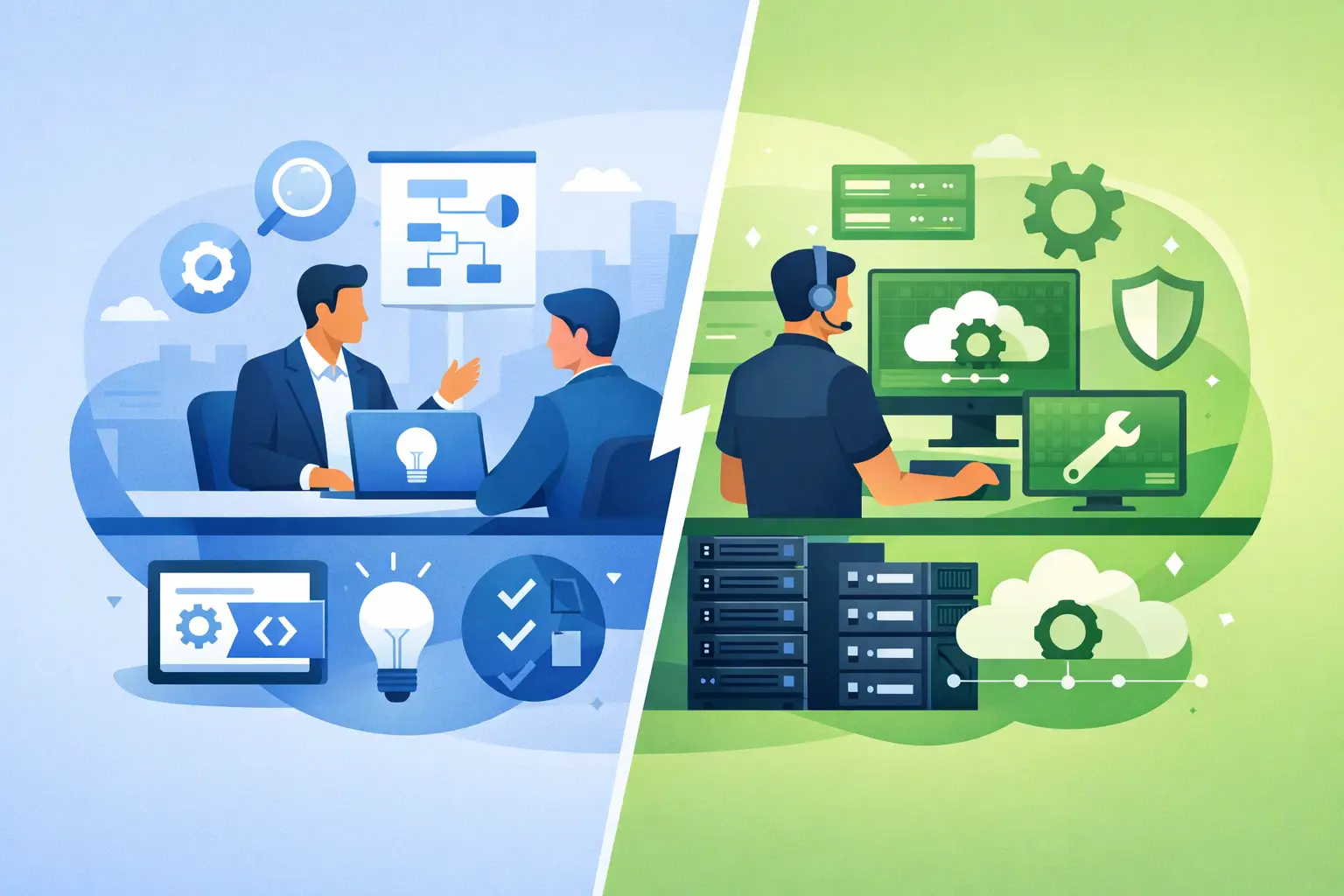
The cleanest way to separate the two is this: consulting changes or fixes the environment; managed services run and maintain the environment.
Consulting asks, “What should this look like, what is broken, and how do we get from here to there?” Managed services asks, “How do we operate this consistently after it is in place?” Consulting is generally finite and outcome-based. Managed services are recurring and process-based.
That does not mean consulting ends with recommendations or managed services never improve anything. Real-world engagements are messier. A managed provider may identify a recurring issue and bring in engineering expertise to correct the root cause. A consulting team may remain involved after implementation to stabilize the new solution. The dividing line is the primary responsibility: transformation versus ongoing operations.
Consider a customer with frequent backup failures. A managed service may verify jobs, respond to alerts, and report on completion rates. But if the backup design cannot meet the business’s recovery requirements, an engineering-led consulting engagement is needed to assess the architecture, dependencies, retention, immutability, recovery workflow, and test process. Once the corrected design is in place, managed services can operate it.
Trying to force both jobs into one generic contract usually leaves someone disappointed. The customer assumes strategic problems are included. The provider assumes they are out of scope. No excuses and no surprises start with an honest service boundary.
When Consulting Is the Better Fit
Consulting is usually the right call when there is a clear change, an urgent unknown, or a capability gap that cannot be solved through standard operations. Common triggers include a failed security assessment, an upcoming migration, performance degradation with no obvious cause, compliance requirements, a major vendor transition, or an incident that has exposed weaknesses in the current design.
It is also the better fit when the customer needs a decision before they need a service. For example, an organization considering Microsoft 365 hardening, a new SIEM, or a data protection redesign should first understand its risk exposure, existing tool overlap, staffing model, and operational maturity. Implementation without that discovery phase often creates shelfware, alert fatigue, and more work for an already stretched team.
For ITSP leaders, consulting can protect client relationships when your team has the trust but not the specialized bench. You do not need to pretend every hard problem fits your standard offering. Bring in subject matter experts, solve the issue properly, and keep the relationship focused on customer success.
When Managed Services Is the Better Fit
Managed services are the better fit when the technology is reasonably stable and the customer needs dependable, continuing coverage. The business may lack 24/7 monitoring, security analysts, cloud administrators, or the discipline to maintain patching, documentation, and recovery testing. These are not one-time needs. They require an operating model.
A managed service is also appropriate after a consulting engagement has completed its work. Once a new security stack, cloud platform, or resiliency architecture is implemented, someone must own the routine tasks that preserve its value. Monitoring, maintenance, change control, incident response, and reporting should not become an afterthought because the project crossed the finish line.
The key is to avoid selling operations as a cure for structural failure. If the environment is unstable, undocumented, or misaligned with business requirements, start with an assessment and remediation plan. Managing a bad design does not make it a good design.
The Strongest Model Often Uses Both
The best client outcomes often come from a deliberate combination. Consulting establishes the facts, defines the target state, and handles the difficult engineering work. Managed services take over the repeatable operational responsibilities once the environment is ready.
This sequence is particularly effective for resilience and security programs. First, assess the actual risk and validate recoverability. Next, engineer the required changes and test the outcome. Then, operationalize monitoring, reporting, maintenance, and periodic exercises. Each phase has a different skill profile, deliverable, and accountability model.
Mavenspire’s SMARTaaS approach follows that practical order: diagnostics and discovery first, followed by the advisory, engineering, and operational services required to reach the outcome. It is not about forcing a customer into a single service bucket. It is about doing the work that the situation demands.
Before proposing either model, ask four direct questions:
- Is the immediate need to operate an established system or change a failing one?
- Does the customer have a defined target state and measurable business requirements?
- Can your current team handle the technical depth, urgency, and risk without compromising existing clients?
- Who will own the environment after the project team leaves?
Those answers expose whether the customer needs a long-term operator, a specialized problem-solving team, or both.
Choose Accountability, Not a Label
The wrong choice between consulting and managed services is rarely caused by terminology. It happens when providers sell what is easiest to package instead of what is necessary to solve the customer’s problem. A recurring contract cannot replace deep engineering when the environment is broken. A one-time project cannot provide the operational discipline needed to keep a critical platform healthy.
Start with the facts. Define the risk. Assign ownership. Then put the right doers, not just talkers, on the work. Your clients will remember who showed up when complexity was blocking progress and got them back to work fast.