


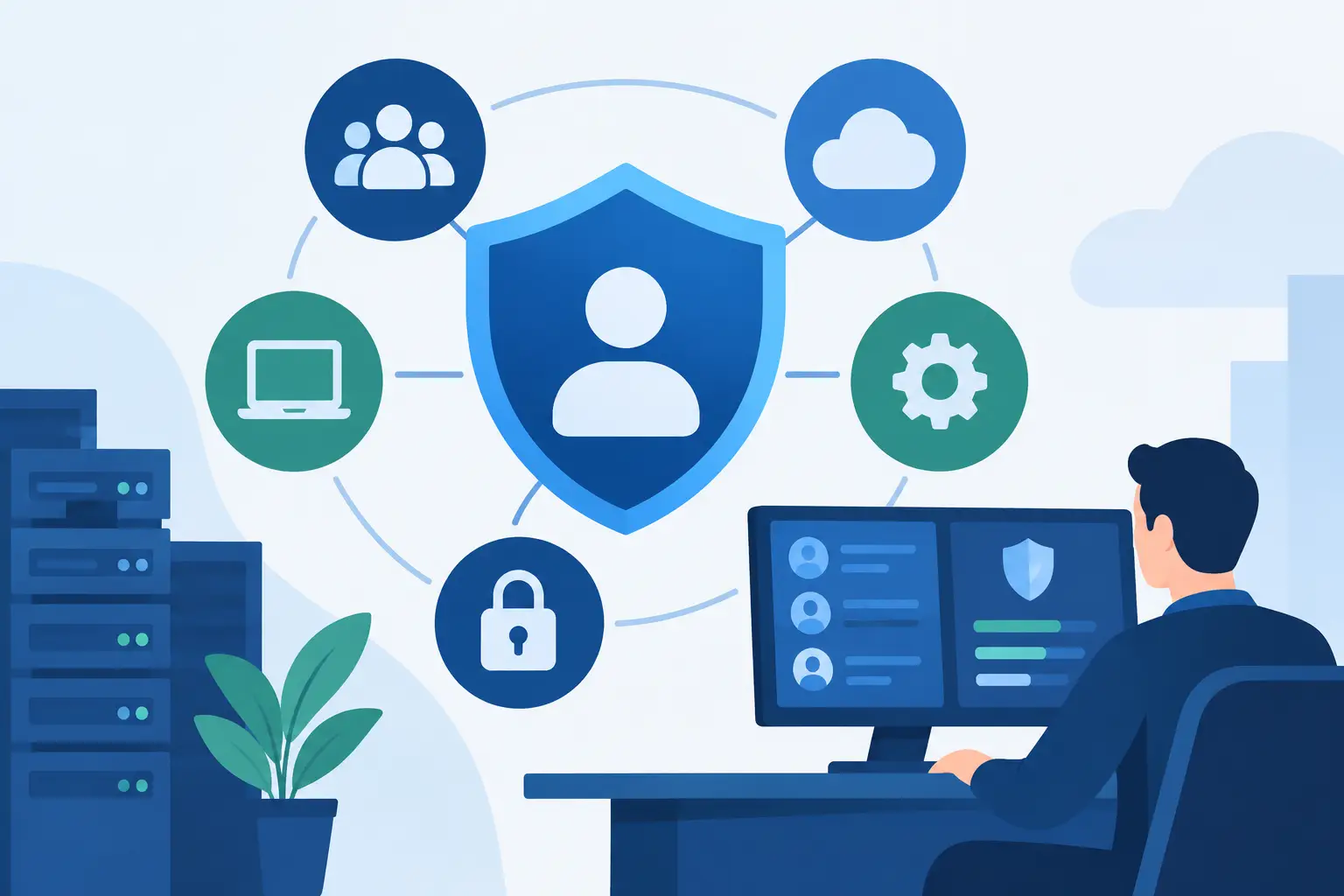
A firewall can be correctly configured, endpoint protection can be reporting green, and a security team can still be one compromised identity away from a bad week. Identity security is where access, privilege, business process, and human behavior collide. That makes it less of a product category and more of an operating discipline.
For MSPs, MSSPs, VARs, and SIs, the challenge is not explaining that identities matter. Customers have heard the passwordless, zero trust, least-privilege pitch. The harder work is finding where their real access model diverges from the diagram, then fixing it without breaking payroll, production, customer support, or the next acquisition.
Why identity security owns the blast radius
Attackers do not need to defeat every control if they can sign in as someone the environment already trusts. A phished administrator, a stale service account, an overprivileged application consent grant, or an unmanaged vendor identity can turn a narrow foothold into broad control.
This is why identity incidents spread so quickly. Identity sits upstream of email, SaaS, cloud consoles, remote access, file platforms, development tools, and line-of-business applications. Once an attacker gains valid access, many security tools see behavior that initially looks legitimate. The attacker is using approved pathways – just with malicious intent.
The business impact is equally broad. A compromised identity can expose data, interrupt operations, lock out administrators, trigger fraudulent payments, or become the launch point for ransomware. The outage is not confined to a single server. It can become a company-wide trust problem.
That is also why identity work belongs in the Security and Resilience pillars of a practical operating model. Prevention matters, but so does the ability to contain access quickly, preserve evidence, restore administrative control, and keep the business moving.
The gaps that survive the “we use MFA” answer
Multi-factor authentication is foundational, but it is not a finish line. Weak implementations can be bypassed through phishing, session theft, MFA fatigue, legacy authentication, or poorly protected recovery methods. A user who approves a fraudulent push request still has MFA. They do not have meaningful protection.
The same pattern appears across identity environments. Organizations often deploy capable platforms while leaving the operational details unfinished. Common examples include service accounts with passwords that never rotate, former employees whose access persists in downstream applications, privileged accounts used for daily email, and third-party users granted permanent access for temporary work.
Cloud environments add another wrinkle. Human identities are only part of the picture. Workloads, automation tools, APIs, managed identities, application registrations, and service principals all require permissions. These non-human identities often accumulate quietly because nobody owns their full lifecycle. They can be less visible than employee accounts and more powerful than either team realizes.
A useful diagnostic question is simple: if a critical identity were compromised at 2:00 a.m., could the team identify its permissions, revoke access across connected systems, rotate affected secrets, and prove that the attacker is out? If the answer depends on three spreadsheets and a few people who are asleep, there is work to do.
Build identity security around real access paths
Strong programs start with visibility, but inventory alone is not the outcome. The goal is to understand how access actually flows through the organization: who receives it, what grants it, where it is enforced, how it changes, and how it is removed.
Establish a usable identity baseline
Map authoritative identity sources, directories, cloud tenants, privileged access systems, key SaaS applications, remote access platforms, and high-impact business systems. Include contractor, partner, emergency, shared, service, and application accounts. Shared accounts deserve special scrutiny because accountability disappears the moment several people use the same credentials.
Then identify the systems that can change the environment. Directory administrators, cloud subscription owners, virtualization administrators, backup operators, security platform administrators, and finance application approvers all represent high-value access. The names and tools vary by customer. The principle does not: access that can alter security, operations, or money needs more control than ordinary user access.
Make privilege temporary and traceable
Standing administrative access is convenient right up until it becomes expensive. Use separate administrative identities, require stronger authentication for privileged roles, and limit the ability to move laterally between management planes. Just-in-time elevation can reduce exposure significantly, but only if the approval workflow is practical enough that engineers will use it during real work.
There is a trade-off here. Excessive friction encourages workarounds, especially during incidents or maintenance windows. The answer is not to relax every control. It is to define documented emergency access, tightly log its use, protect it with stronger safeguards, and review it afterward. Break-glass access should be a net under the wire, not a master key left under the mat.
Treat lifecycle automation as a security control
Joiner, mover, and leaver processes are often filed under HR or IT operations. They are security controls with business consequences. New hires need the right access on time. Employees changing roles need old permissions removed, not merely new permissions added. Departing employees and contractors need access revoked across every connected system, including SaaS applications that may not be visible to central IT.
Automation helps, but only when the source data is trustworthy and exception handling is clear. A poorly designed workflow can remove access from the wrong person just as efficiently as it can remove risky access. Start with critical systems, test carefully, and build ownership for resolving exceptions.
Protect applications and workload identities
Application access deserves the same engineering discipline as human access. Review consent grants, API permissions, secrets, certificates, token lifetimes, and ownership. Eliminate orphaned applications. Replace long-lived secrets where possible with managed or federated identities. Scope permissions narrowly, because an application with broad mail, file, or directory access can give an attacker a very efficient path through the environment.
This is an area where configuration review needs to be paired with architecture. The right control depends on the application, the cloud platform, the integration pattern, and the operational team that must support it. Cookie-cutter hardening guides are useful starting points, not an engineering plan.
Detection and recovery are part of the design
Identity security cannot rely on prevention alone. Assume a credential or token will eventually be stolen. The practical question is whether the organization can spot unusual access and act before that access becomes an enterprise incident.
Detection should focus on high-signal events: new privileged role assignments, suspicious consent activity, impossible or unusual sign-ins, changes to authentication methods, modifications to conditional access policies, disabled logging, and unexpected use of emergency accounts. Alerts without ownership are just expensive noise, so define who investigates, what evidence they need, and when they can disable an account without waiting for a committee meeting.
Recovery plans should be rehearsed, not admired in a document repository. A serious identity recovery exercise tests whether administrators can regain control if primary accounts, authentication methods, federation settings, or directory roles are compromised. It also tests dependencies. Can backup systems be accessed independently? Are emergency accounts protected and monitored? Can the team restore access without restoring the attacker?
For channel partners, this is where senior engineering depth matters. A customer may need an assessment, an architecture plan, hands-on implementation, incident containment, or an embedded engineer who can carry the work across all five. Mavenspire supports that execution behind the partner brand, so the customer gets the capability without the partner surrendering the relationship.
Measure what changes risk
Identity programs can drown in counts that look good on a slide and say little about exposure. Measure the conditions that matter: privileged accounts using phishing-resistant authentication, dormant accounts removed, critical applications covered by lifecycle controls, service accounts with known owners, and time required to revoke access during an incident.
Also measure exceptions. Every exception has a reason, an owner, an expiration date, and a compensating control – or it is simply unmanaged risk with a polite label. Exceptions are not failure. Forgotten exceptions are.
The right identity security program will look different for a 200-person professional services firm, a multi-site manufacturer with operational technology, and a cloud-native software company. But the operating principle holds: know who and what can act, constrain unnecessary privilege, watch for dangerous change, and practice taking control back. When identity becomes a managed operational system rather than a quarterly cleanup project, attackers have far less room to work.