


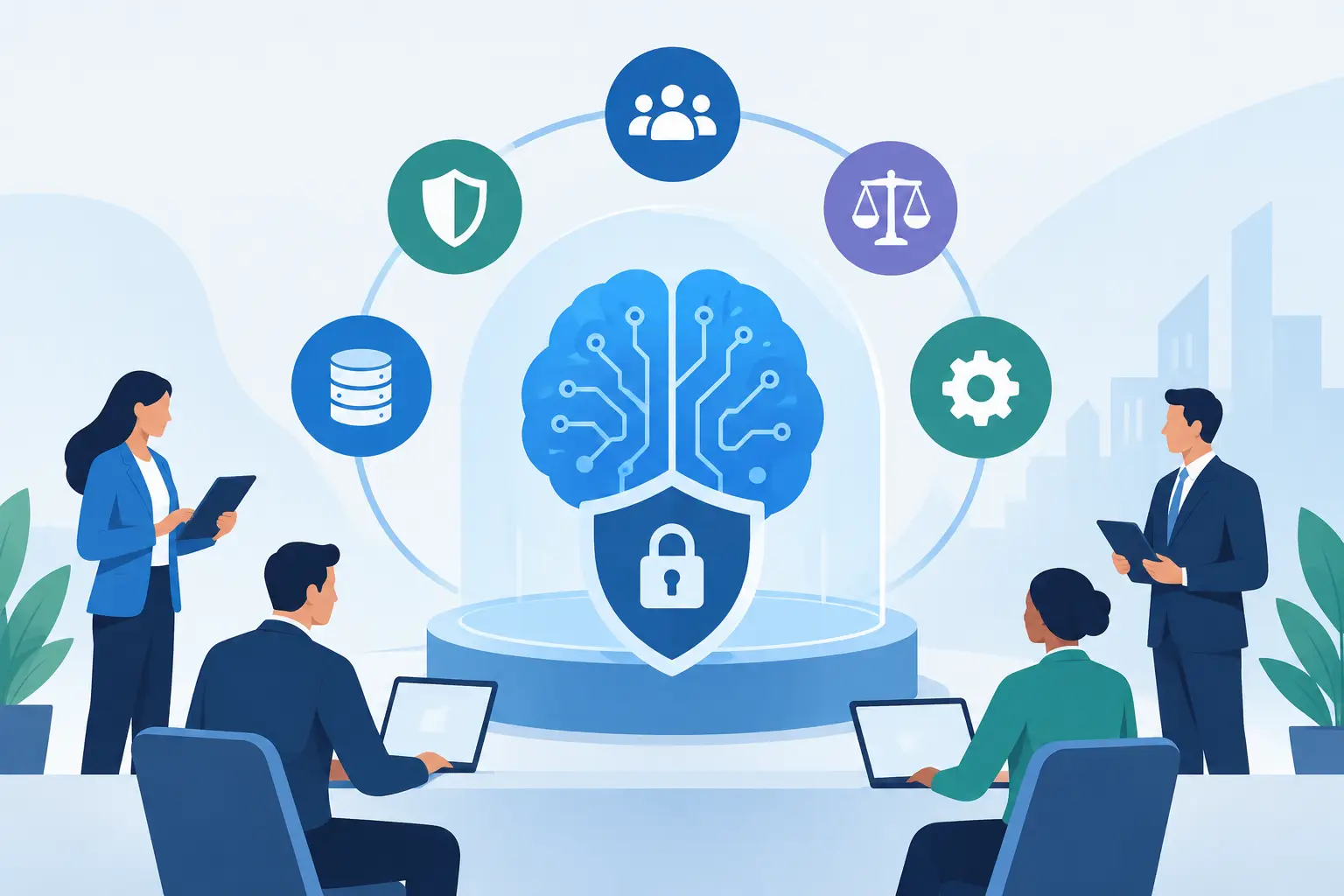
A business unit can deploy a generative AI tool in an afternoon. Undoing a data exposure, a bad automated decision, or a customer-facing hallucination takes considerably longer. That is why enterprise AI governance cannot be a policy document collecting dust in a shared drive. It has to be an operating discipline that lets teams use AI productively without turning every prompt, workflow, and vendor integration into a new blind spot.
For MSPs, MSSPs, VARs, and systems integrators, the stakes are doubled. You may be advising the customer, implementing the platform, supporting its security controls, and protecting your own brand while doing it. The goal is not to say no to AI. The goal is to make sure the answer is yes for the right use cases, with the right data, guardrails, owners, and recovery plan.
Why Enterprise AI Governance Fails in Practice
Most governance programs fail for a simple reason: they start with abstraction instead of operations. A committee writes broad principles around fairness, transparency, and responsible use. Those principles are valid, but an engineer configuring a copilot tenant or a service desk manager automating ticket triage still needs practical answers. Which data classifications can enter the model? Who approves a new AI vendor? What happens when the model provides a wrong answer? Where are the logs? Who can turn the workflow off?
The other failure mode is treating all AI as the same risk. An internal assistant that drafts meeting notes is not the same as a model that influences credit decisions, diagnoses equipment faults, generates production code, or summarizes a security incident. The controls should match the consequence. If every use case gets a full risk review, the business routes around governance. If no use case gets one, you have shadow AI with better marketing.
A workable program uses tiers. Low-impact tools may need an approved vendor, acceptable-use rules, and basic data controls. Higher-impact systems need testing, human review, monitoring, documented decision logic, and a defined escalation path. High-risk use cases may require legal, security, compliance, and business approval before launch. It depends on the data, the decision being influenced, the customer impact, and the organization’s regulatory exposure.
Start With an AI Inventory, Not an AI Policy
You cannot govern what you cannot see. Before debating advanced model controls, establish an inventory of AI already in use. Include sanctioned platforms, embedded features in existing SaaS products, pilot projects, internally built models, automation tools, and the unofficial browser tabs people use because they save time.
The inventory should capture the business owner, technical owner, vendor or model, data sources, intended users, affected customers, connected systems, and the decisions or actions the tool can influence. It should also record where prompts, outputs, and telemetry are retained. That last detail is where many teams get surprised. A tool may look harmless until you learn that users are pasting customer records, source code, credentials, or incident details into it.
This is not an exercise in catching employees doing something wrong. It is a way to replace guesswork with a factual starting point. If the approved path is slow, unclear, or missing, capable people will create their own. Build a path that moves at business speed while making the safe choice the easy choice.
Classify Data Before It Reaches the Model
Data governance and AI governance are now joined at the hip. A model cannot protect data your organization has never classified, nor can it apply meaningful access controls if identities and entitlements are a mess.
At minimum, define what data may be used in public AI services, enterprise AI services, private models, and retrieval systems connected to internal repositories. Public models should generally receive only information intended for public release. Enterprise services may support more sensitive workloads, but only after the organization verifies contractual protections, retention settings, training-use terms, tenant isolation, identity integration, and audit capabilities.
For retrieval-augmented generation, do not assume a user’s question should grant access to every document the model can find. The AI layer must honor existing permissions. Otherwise, a friendly chat interface becomes a very efficient way to expose restricted content.
Put Clear Owners Around Every Decision
AI governance is not owned by the AI committee because committees do not operate systems at 2:00 a.m. Assign accountable people for the business outcome, data, model or vendor, security controls, and ongoing operations. The ownership model can be lean, but it must be real.
The business owner decides whether the use case delivers value and accepts the operational trade-offs. The technical owner maintains integrations, configurations, and change control. Security and privacy teams define required safeguards. Legal and compliance teams help identify obligations. Frontline operators report failure patterns that a dashboard may miss.
For channel partners, the line of responsibility needs additional care. Be explicit about whether the partner is advising, implementing, monitoring, responding, or simply providing a platform under the customer’s control. White-label delivery does not change accountability. It makes clean runbooks, approval records, and escalation procedures even more important. Nobody wants to discover during an incident that everyone assumed someone else was watching the model.
Build Controls Across the PRISM
A practical enterprise AI governance program should look like the environment it protects: interconnected, measurable, and prepared for failure. Mavenspire’s PRISM lens provides a useful way to organize the work without turning it into buzzword soup.
Performance: Prove the System Helps
Define what good looks like before deployment. That might be faster ticket resolution, fewer manual review hours, higher knowledge-base findability, or reduced time to produce first drafts. Measure quality alongside speed. A fast answer that sends an engineer down the wrong troubleshooting path is not a win.
Test models against realistic prompts, edge cases, incomplete inputs, and known bad scenarios. Establish acceptance thresholds and re-test after significant model, prompt, data, or integration changes. Model behavior can drift even when your own code does not.
Resilience: Plan for Wrong Answers and Outages
Every AI-enabled process needs a graceful failure mode. Can staff complete the work manually if the service is unavailable? Can they identify and correct a bad output before it reaches a customer? Is there a kill switch for an autonomous workflow that starts behaving badly?
For consequential use cases, preserve enough logs to reconstruct what happened: the prompt or triggering event, relevant retrieved content, model version, output, human action, and downstream system changes. Logging must be balanced with privacy and retention requirements, but no evidence means no meaningful investigation.
Innovation: Create a Safe Route to Production
Innovation needs a runway, not a free-for-all. Establish a lightweight intake process where teams can describe the use case, expected benefit, data involved, affected systems, and risk tier. Give them a sandbox for experimentation with nonproduction data whenever possible.
A good program also makes room for retirement. If a pilot does not produce value, shut it down cleanly. Remove data connections, revoke access, document the outcome, and move on. Keeping every experiment alive is not innovation. It is infrastructure clutter with a clever name.
Security: Treat AI as an Attack Surface
AI systems introduce familiar security problems in unfamiliar packaging: excessive permissions, third-party risk, data leakage, insecure APIs, compromised identities, and weak monitoring. They also add model-specific threats, including prompt injection, malicious retrieved content, data poisoning, and attempts to extract sensitive information through carefully crafted queries.
Apply the basics with discipline. Use strong identity controls and least privilege. Segment integrations. Protect secrets. Review vendor security practices and contractual terms. Monitor unusual usage and administrative changes. Test whether a model can be manipulated into ignoring instructions or taking unsafe actions through untrusted content.
If an AI agent can send email, modify records, execute scripts, or open support tickets, it is not just a chatbot. It is a privileged automation account with a conversational interface. Govern it accordingly.
Migration: Control Change, Not Just Deployment
AI deployments change quickly. Vendors revise models, alter terms, deprecate features, and shift data-processing locations. Internal teams update prompts, connectors, and automation logic. Each change can alter risk.
Maintain a change process that records what changed, who approved it, what was tested, and how to roll back. For critical workflows, avoid making production changes solely through an admin console with no record beyond a screenshot. Treat prompts, evaluation sets, policies, and configurations as controlled assets.
Make Monitoring an Operating Habit
Governance does not end at go-live. Monitor adoption, cost, output quality, security events, and exception patterns. A sudden spike in usage may signal success, but it may also indicate a team has begun feeding the tool information it should not have. A falling acceptance rate may show model drift, a broken retrieval source, or users losing trust.
Create an incident path specifically for AI failures. Define what qualifies as a reportable event, who investigates, when systems are paused, and how customers are notified if they are affected. Then exercise it. Cyber defense takes a village, and AI incidents will cross security, operations, legal, data, and business teams faster than a traditional application issue.
The best enterprise AI governance is not the thickest binder or the most restrictive gate. It is the set of practical controls that helps good teams move with confidence, catches trouble early, and gives people a net under the wire when automation gets creative.