


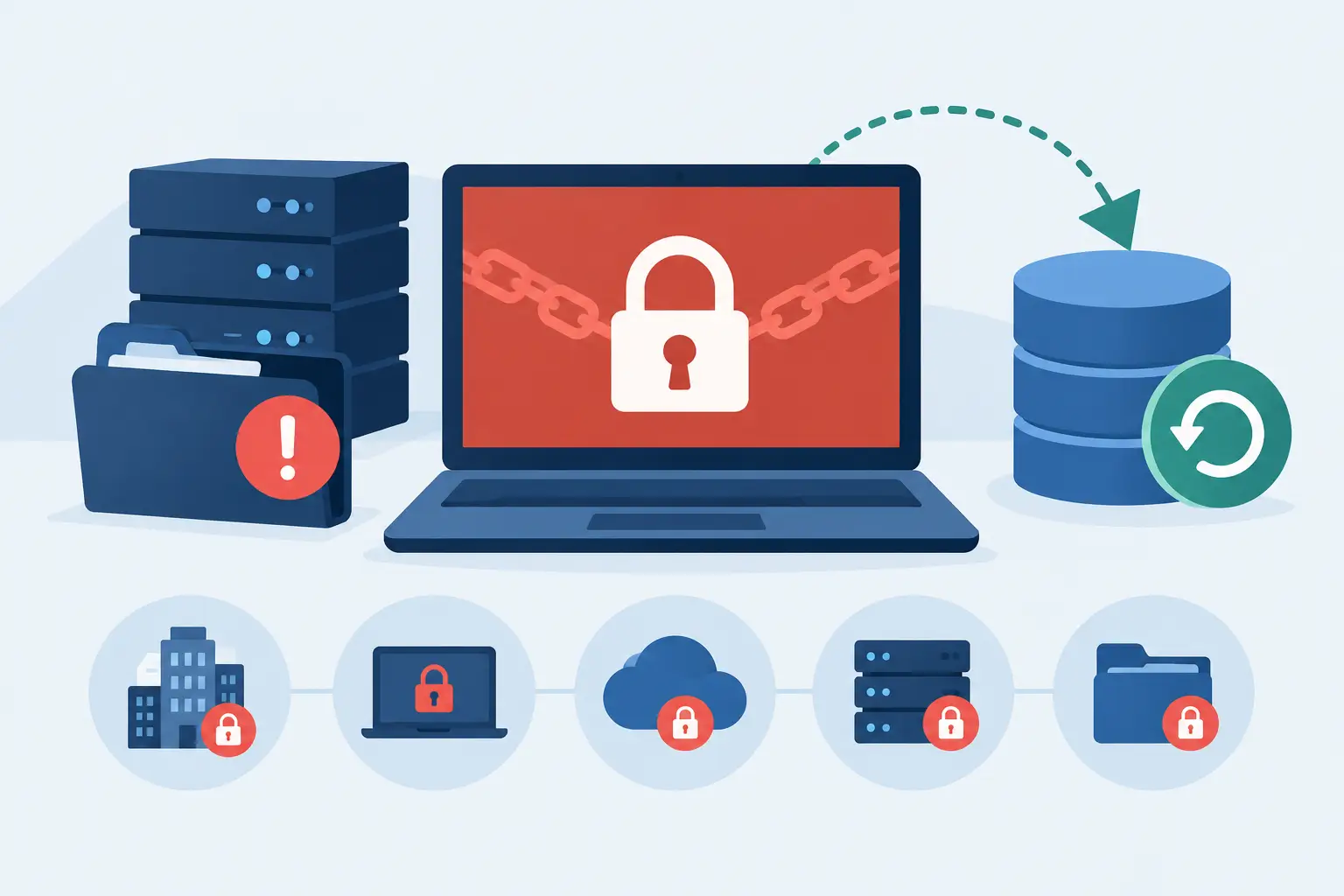
A ransomware event does not test whether an organization bought backup software. It tests whether it can make hard decisions, isolate damage, validate clean systems, and restore the right business services in the right order. These ransomware recovery examples show why the difference between “we have backups” and “we can recover” is usually measured in painful hours, lost revenue, and customer confidence.
For MSPs, MSSPs, VARs, and SIs, the lesson is equally direct: recovery is a delivery capability, not a product checkbox. Your client still owns the outage, even when the incident starts in a third-party application, a neglected identity tenant, or a misconfigured backup repository.
1. The Backups Worked, but the Business Stayed Down
A regional distributor was hit by ransomware that encrypted file servers, several virtual machines, and a line-of-business application server. The IT team had nightly backups, an off-site copy, and enough storage capacity to retain the data. On paper, this should have been a straightforward restore.
It was not.
The team restored file shares first because users were loudly asking for them. But the warehouse management system depended on a database server, application server, identity services, and network shares being restored in a specific sequence. The backups were usable, yet the environment lacked a documented application dependency map and tested recovery runbook. Three days later, workers were still using paper pick tickets while engineers untangled service accounts, DNS records, and database version mismatches.
The recovery problem was not backup failure. It was recovery design failure.
The fix starts with business impact analysis. Identify the services that actually keep revenue moving, then map their dependencies: identity, DNS, certificates, databases, storage, network segments, SaaS integrations, and vendor support requirements. Define recovery time objectives by service, not by server. A payroll system may tolerate a day. Warehouse processing may not tolerate four hours.
This is where resilience becomes operational rather than aspirational. A recovery plan needs an agreed restoration order, named decision-makers, credentials stored outside the affected environment, and regular tests that prove the sequence works. Restoring data is one task. Restoring a business is the assignment.
2. The Backup Repository Was Encrypted Too
A professional services firm discovered ransomware on a Monday morning. Attackers had compromised an administrator account days earlier, moved laterally, and used the same broad privileges to access the backup platform. Production was encrypted, but so were the backups that lived on a reachable repository.
The firm had paid for backup. It had not designed for an attacker who understood backup.
The recovery team found an older archive copy, but it was incomplete and required manual reconstruction of several recent client records. More damaging than the data gap was the delay. Nobody could immediately confirm whether the archive was clean, what it contained, or how quickly it could be restored into an isolated environment.
A backup copy is not automatically a recovery copy. It must be protected from the identity plane and management plane that attackers are likely to compromise first. That usually means separate administrative roles, multifactor authentication, restricted management access, immutable retention where appropriate, and copies isolated by account, network, or platform.
There are trade-offs. Immutability can complicate retention management. Air-gapped processes can add operational overhead. Separate credentials create more access administration. Good. Recovery should have some friction. The goal is not to make backups convenient for every administrator. The goal is to make them difficult for an intruder to erase or encrypt.
3. The Restore Was Clean, but the Attacker Came Back
A manufacturer recovered virtual machines from known-good backups after a ransomware incident. Systems came online, users returned, and production resumed. Two weeks later, suspicious logins appeared from the same foreign infrastructure observed during the first breach.
The ransomware payload was gone. The persistence mechanism was not.
The original investigation had focused on decryption and restoration. It had not fully addressed the compromised identity environment, exposed remote access path, or privileged accounts created during the intrusion. Restoring servers without containing the root cause simply gave the attacker a repaired house with the old keys still under the mat.
A defensible recovery has two tracks running in parallel. One track restores business services. The other performs containment, evidence preservation, threat hunting, and eradication. Depending on the event, that can include resetting privileged credentials, revoking active sessions and tokens, rebuilding identity infrastructure, reviewing conditional access policies, rotating service account secrets, and validating endpoint telemetry before systems rejoin production.
This is an area where speed and certainty pull against each other. Executives understandably want operations back now. Security teams need enough time to confirm the environment is safe. The answer is not to let either side win by volume. Build predefined recovery tiers and clean-room options so the organization can restore essential operations while the broader investigation continues.
4. The Cloud Tenant Was the Real Blast Radius
A healthcare-adjacent organization assumed its cloud collaboration suite was safe because it was SaaS. When ransomware hit endpoints and file servers, the team expected email, documents, identity, and collaboration tools to remain available.
Instead, attackers used a compromised administrator account to alter mailbox rules, register malicious applications, access shared files, and delete or encrypt cloud-hosted content. The organization had treated SaaS availability as if it were the same thing as data protection and tenant recovery.
Cloud platforms provide substantial resilience, but shared responsibility still applies. The provider protects the platform. The customer remains responsible for identities, access controls, configuration, retention choices, and recovery of data or settings that users and administrators can change.
The practical recovery work included disabling risky application registrations, reviewing consent grants, revoking refresh tokens, restoring deleted data where possible, and rebuilding conditional access policies from a validated baseline. It also required a careful communications plan because email could not be assumed trustworthy during the investigation.
For channel partners, this example matters because cloud recovery often crosses disciplines. Identity engineering, endpoint security, SaaS configuration, data protection, and incident response all show up at once. Cyber defense takes a village, but somebody still has to coordinate the village.
5. The Recovery Plan Existed Only as a PDF
A multi-site organization had a comprehensive incident response and disaster recovery plan. It was approved, stored in a shared drive, and reviewed annually. During a ransomware event, that shared drive was unavailable. The latest contact list was outdated, the cyber insurance hotline had changed, and no one could locate the emergency vendor escalation path.
The plan was technically complete and operationally useless.
Recovery documentation must be available when core systems are not. Keep controlled offline copies of critical procedures, contact lists, network diagrams, restoration priorities, and break-glass credentials. More importantly, practice using them. A tabletop exercise can expose unclear authority. A technical recovery test can reveal missing firewall rules or expired credentials. A full simulation can show whether business leaders know who is authorized to take systems offline, notify customers, engage counsel, or approve emergency spending.
Do not confuse an annual review with readiness. Plans decay as infrastructure changes, staff turns over, vendors shift, and applications move to the cloud. Recovery documentation needs change control just like production architecture.
What These Ransomware Recovery Examples Have in Common
Across these ransomware recovery examples, the recurring failure is not a lack of technology. It is a lack of verified assumptions. Teams assume backups are isolated, identity is intact, documentation is accessible, SaaS is recoverable, and application dependencies are understood. Ransomware is very good at collecting the bill for those assumptions.
A practical recovery posture combines the PRISM disciplines. Performance matters because recovery capacity and restoration speed affect revenue. Resilience means protected copies, documented dependencies, and tested failover paths. Innovation helps automate validation and orchestration where it reduces human error. Security drives identity hardening, segmentation, monitoring, and threat eradication. Migration planning matters because the cleanest recovery may involve moving critical workloads into a newly built environment rather than rebuilding a compromised one in place.
For partners delivering these services under their own brand, the strongest motion is not selling a generic “ransomware package.” Start with an assessment that identifies recovery gaps, then turn findings into an executable roadmap: protect the backups, reduce privileged access, document dependencies, build clean recovery paths, and test against realistic scenarios. Senior engineering depth matters here because recovery plans tend to fail at the seams between platforms.
Mavenspire approaches that work as engineering work, not slideware. The objective is drama-free outcomes when the stakes are anything but drama-free.
The best time to discover that a recovery plan has missing pieces is during a scheduled test with coffee nearby. The second-best time is before the next alert becomes a business outage.