
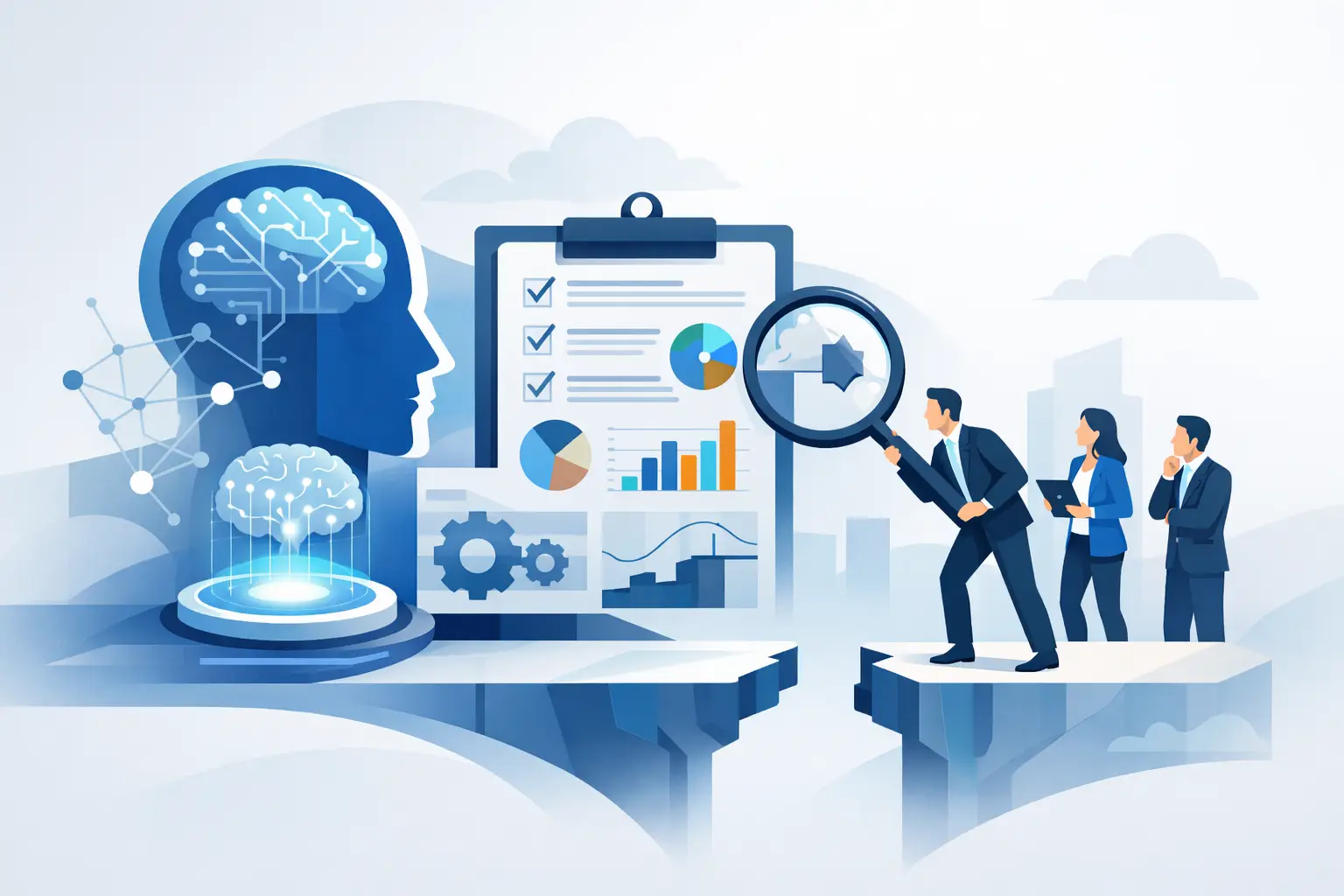
A promising AI demo can hide a very expensive reality: data nobody trusts, identities nobody can govern, integrations that cannot carry production traffic, and teams with no clear owner after launch. An enterprise AI readiness assessment separates a useful business capability from a pilot that becomes shelfware with an impressive slide deck.
For MSPs, MSSPs, VARs, and SIs, this matters twice. Your customer needs a practical path to AI outcomes, and you need to protect the relationship by setting expectations that engineering can actually meet. The right assessment does not sell fear or produce a 70-page report that collects dust. It identifies what is ready, what is risky, what must change first, and who needs to do the work.
Why enterprise AI readiness is an operating question
AI discussions often begin with a model. The more useful starting point is the business process. Is the goal to reduce time spent triaging tickets, improve forecasting, accelerate proposal development, assist field technicians, identify fraud, or help security teams investigate alerts? Each objective creates different data, latency, privacy, integration, and human-review requirements.
That distinction keeps organizations from treating AI as a single platform decision. A retrieval-based assistant for internal policy questions has a different risk profile than an agent that can change customer records, trigger workflows, or influence clinical, financial, or safety-related decisions. Both may use similar models. They should not share the same approval path or control set.
Readiness also changes over time. A company with clean identity controls and mature data pipelines may be ready for a narrow production use case even if it is not prepared for autonomous workflows. Another organization may have strong data scientists but weak access governance, making broad adoption a security problem waiting for a calendar invite.
What an enterprise AI readiness assessment should examine
A useful assessment looks across the systems that make AI useful and supportable. It should be specific enough to expose technical blockers, but connected to business priorities so the remediation plan earns sponsorship.
Business value and use-case discipline
Start by ranking use cases according to measurable impact, implementation effort, risk, and dependency depth. “Improve productivity” is not a use case. “Reduce average ticket-resolution time for Tier 1 password and access requests while maintaining documented human escalation” is something a team can design, test, and measure.
The assessment should identify the process owner, expected benefit, affected users, required systems, failure modes, and decision rights for every prioritized use case. It should also name the use cases that are attractive but premature. This is not negativity. It is how teams avoid wiring an AI assistant into a process that was already broken before the model showed up.
Data quality, access, and lifecycle
AI is often framed as a model challenge. In enterprise environments, it is usually a data and access challenge wearing a model-shaped hat. An assessment should determine where the relevant data lives, whether it is current, whether classifications are reliable, and whether access permissions can be enforced at query time.
The key question is not simply, “Can we connect this repository?” It is, “Will the system return the right information to the right person, and can we prove why?” Stale knowledge bases, duplicated records, incomplete metadata, and undocumented retention policies become fast paths to inaccurate output and accidental exposure.
Data readiness includes the plumbing: APIs, integration patterns, ingestion processes, observability, storage costs, and network constraints. A proof of concept can survive manual file uploads. Production cannot depend on them.
Security, identity, and compliance
If an AI application can see sensitive information, it becomes part of the security architecture. If it can take actions, it becomes part of the control plane. That requires more than a checkbox confirming that a provider has security documentation.
Evaluate identity federation, role and attribute-based access, privileged access controls, service accounts, secrets management, logging, encryption, tenant separation, and incident-response procedures. Review whether prompts, uploaded files, retrieved content, and model outputs are retained, where they are processed, and how that behavior aligns with contractual and regulatory obligations.
Security teams also need to address AI-specific attack paths. Prompt injection, data exfiltration through tool calls, poisoned knowledge sources, excessive agent permissions, and unreviewed third-party integrations are operational risks, not science fiction. The appropriate controls depend on the use case. A read-only internal assistant may require strict content filtering and retrieval permissions. An agent with workflow access needs approval gates, constrained tools, transaction logs, and a very small blast radius.
Architecture, resilience, and performance
Production AI workloads put pressure on infrastructure in ways a demo does not reveal. Assess compute and capacity needs, model-provider dependencies, network egress, API quotas, failover options, cost controls, monitoring, and service-level expectations. A customer-facing assistant that takes 20 seconds to respond might be acceptable for a complex request, but disastrous for a high-volume support workflow.
Resilience deserves special attention. What happens when a model endpoint is unavailable, a retrieval service fails, a connector returns bad data, or a provider changes a model version? Teams need known fallback behavior. Sometimes the answer is a simpler search experience or a routed human queue. A degraded service is far better than an invisible failure that quietly produces wrong answers.
Governance, people, and operating ownership
The assessment must answer a question many AI plans dodge: who owns this after go-live? Product owners may own value realization, IT may own integration, security may own guardrails, legal and compliance may set policy, and operations may own incident handling. Those responsibilities need to be explicit before a system begins making recommendations that employees trust.
Governance should be proportionate. A small internal summarization tool should not need the same oversight as an AI system that influences hiring, credit, pricing, safety, or regulated decisions. But every production implementation needs a way to approve changes, test for quality and safety, monitor outcomes, collect user feedback, and retire the system when it no longer serves the business.
Training is part of this operating model. Users need to understand what the system can do, what it cannot verify, when to escalate, and what data they must not submit. AI literacy is not a one-hour compliance video. It is a working agreement between the people using the tool and the people accountable for its behavior.
Turn findings into a delivery plan
The assessment is only valuable if it produces decisions. A strong final deliverable gives leadership a prioritized roadmap rather than a vague maturity score. It should distinguish quick wins from foundational work, show dependencies, identify risk owners, estimate delivery effort, and define success measures.
A practical roadmap commonly moves through four workstreams:
- Foundation: remediate identity, data classification, network, integration, and logging gaps that would make production unsafe or unmanageable.
- Controlled pilots: deploy narrow use cases with limited audiences, documented success metrics, and human oversight.
- Production engineering: add monitoring, access controls, testing, support processes, cost management, and resilience patterns.
- Scale governance: standardize reusable patterns so each new use case does not require reinventing security, architecture, and approval processes.
The sequence is not always linear. An organization may run a low-risk pilot while improving data governance, provided the pilot is properly fenced in. What should not happen is letting an executive demo become a de facto production system because people started relying on it before anyone assigned ownership.
For channel partners, this roadmap also clarifies the delivery model. Your team may lead business discovery and customer management while a senior engineering partner validates architecture, builds controls, or supplies specialized resources under your brand. That approach expands capability without forcing an MSP or SI to staff every specialty permanently. Mavenspire uses its PRISM lens – Performance, Resilience, Innovation, Security, and Migration – to keep those workstreams connected instead of treating AI as an isolated add-on.
Common assessment mistakes that create expensive rework
The first mistake is scoring maturity without testing the actual path to production. A company can receive high marks for having a cloud strategy and still lack a governed way for an AI application to access the documents it needs.
The second is treating security as the last gate. When identity, data boundaries, logging, and vendor terms are considered after a prototype is popular, remediation becomes politically harder and technically more costly.
The third is overcorrecting into analysis paralysis. Not every AI use case demands a year-long data modernization program. The goal is to find a use case whose value and risk fit the organization’s current capabilities, then build the next layer with evidence rather than optimism.
A readiness assessment should leave teams with a clean answer to a practical question: what can we deploy safely in the next 90 days, and what groundwork will make the next five deployments easier? That is where AI stops being a boardroom aspiration and starts becoming an operating advantage.